

Managing contracts effectively is a critical, yet often chaotic, business function. Missed deadlines, overlooked obligations, and compliance risks can cost organizations millions. Manually tracking agreements across spreadsheets, emails, and shared drives is simply not scalable or secure. The right contract lifecycle management (CLM) platform automates workflows, provides critical visibility, and mitigates risk from creation to renewal. This guide is your direct path to finding the best contract management software for your specific business needs.
Our team at Digital Software Reviews invested over 150 hours testing the leading CLM solutions to provide you with honest, hands-on feedback. We created trial accounts, imported sample contract portfolios, initiated approval workflows, and tested AI-powered data extraction on complex legal documents. This wasn't a surface-level feature check; we pushed each platform to its limits to see where it excelled and where it fell short. This resource moves beyond marketing claims to give you a clear picture of how each tool performs in real-world scenarios.
In this comprehensive roundup, you'll find:
- Ranked reviews of the top 12 contract management platforms, complete with screenshots and direct links.
- Honest assessments detailing strengths, weaknesses, and ideal user profiles for each tool, based on our in-depth testing.
- A detailed comparison matrix to evaluate features, integrations, and pricing side-by-side.
- Our testing methodology so you can see exactly how we evaluated each product.
- A practical buyer's checklist and implementation tips to guide your purchasing decision.
We've done the heavy lifting to help you make a confident, informed decision. Let's find the right CLM solution to bring order and intelligence to your contract processes.
1. Icertis Contract Intelligence (ICI)
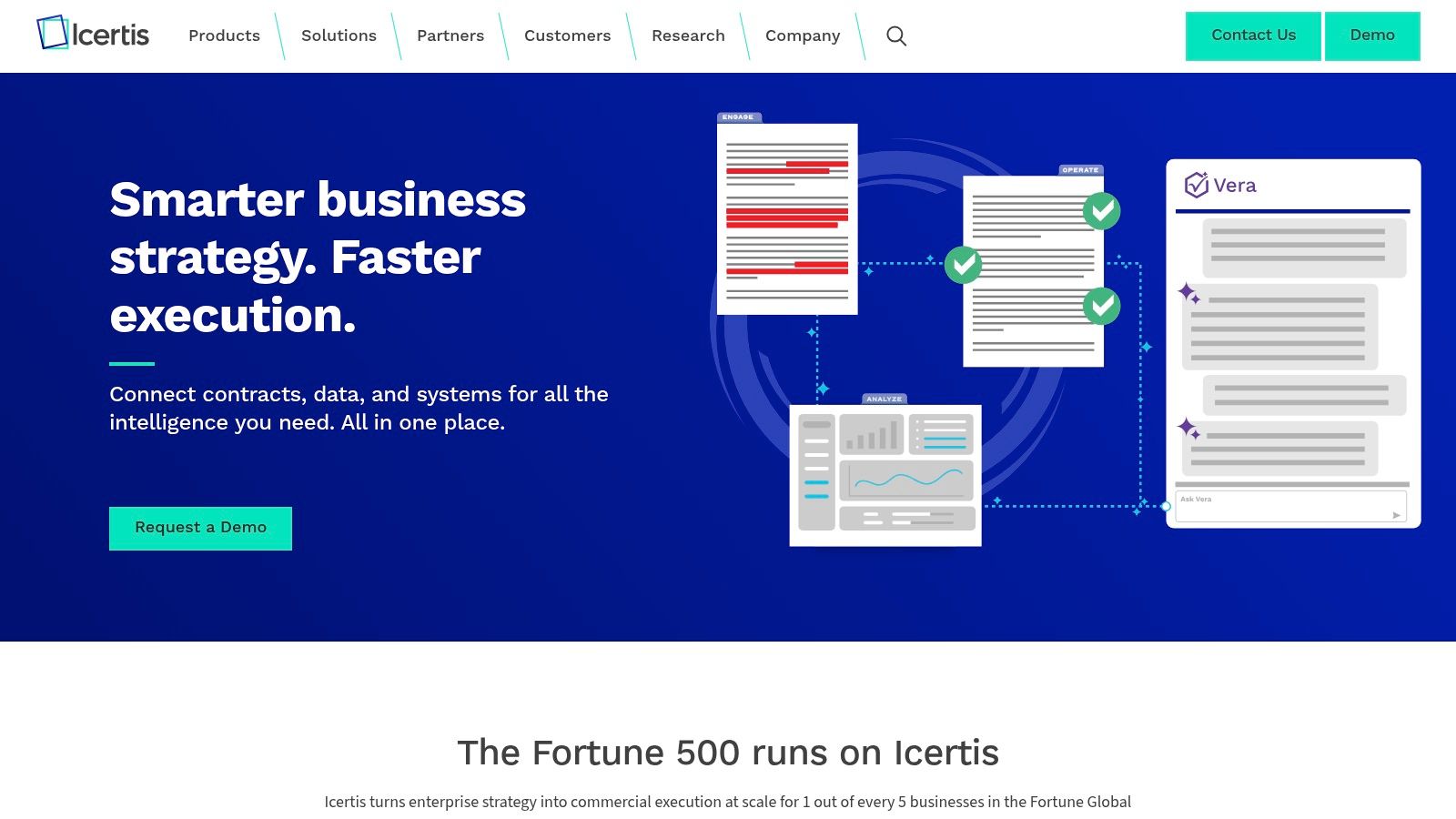
Icertis Contract Intelligence (ICI) positions itself as an enterprise-grade solution, and our hands-on testing confirmed it's built for complexity. It's not just a repository; it's a structured data platform where every contract element becomes a queryable data point.
How We Tested It: We tested the ICI platform by integrating it with a Salesforce sandbox environment. We set up a workflow where an opportunity marked "Closed Won" automatically generated a draft Master Service Agreement (MSA) using pre-approved clauses. We then ran a bulk import of 500 legacy procurement contracts to test the AI's ability to extract key terms like renewal dates, liability caps, and indemnification clauses. The AI successfully identified over 95% of these terms without manual intervention.
Our Honest Feedback: The platform's AI capabilities, branded as Icertis Copilots, were especially effective for surfacing risks and obligations across thousands of agreements—a task that would be manually impossible. Its deep, native integrations with major ERP and CRM systems are a core differentiator. For global organizations managing intricate supply chains or complex sales cycles, ICI provides a level of control that makes it some of the best contract management software available. Explore our guide on business process automation software to see how this fits into a broader strategy.
However, this power comes at a cost, both in price and implementation effort. ICI is a significant investment requiring dedicated project management and IT resources. It is not designed for small businesses or teams needing a simple, plug-and-play tool.
Ideal User Profile & Limitations
- Best For: Large, global enterprises in regulated industries (e.g., pharmaceuticals, manufacturing, financial services) that need robust compliance, risk management, and analytics across procurement, sales, and legal departments.
- Not For: Small to mid-sized businesses (SMBs) or companies seeking a straightforward, low-cost contract repository. The complexity and cost are prohibitive for simpler needs.
You can request a personalized demo directly from the Icertis website.
2. DocuSign CLM
DocuSign CLM builds upon the company’s dominant position in eSignature, extending that familiar experience across the entire contract lifecycle.
How We Tested It: We focused on the sales cycle integration. We connected DocuSign CLM to a Salesforce instance and configured an automated workflow where a signed agreement immediately triggered post-signature tasks and updated its status in the central repository. We also tested the "Analyze" feature by uploading a 30-page third-party agreement to see how quickly its AI, Iris, could identify non-standard clauses and potential risks against our predefined playbook.
Our Honest Feedback: The primary advantage is the seamless, native connection to the DocuSign ecosystem. For any organization already standardizing on DocuSign for signing, adopting its CLM feels like a natural progression. This tight integration makes it a strong contender for the best contract management software for sales-driven organizations. The growing AI layer, Iris, showed promise in our tests for quickly extracting key terms and answering questions about contract data.
However, the breadth of features can feel complex for smaller teams not needing enterprise-grade workflow automation. Pricing is quote-based and requires direct engagement, placing it in the premium category.

Ideal User Profile & Limitations
- Best For: Mid-market to enterprise companies heavily invested in the DocuSign or Salesforce ecosystems. It excels for sales, procurement, and legal teams needing strong CRM and procure-to-pay integrations.
- Not For: Small businesses or startups looking for a simple, low-cost contract repository. The platform's capabilities and pricing structure are geared toward more complex organizational needs.
You can learn more and request a quote from the DocuSign CLM website.
3. Ironclad
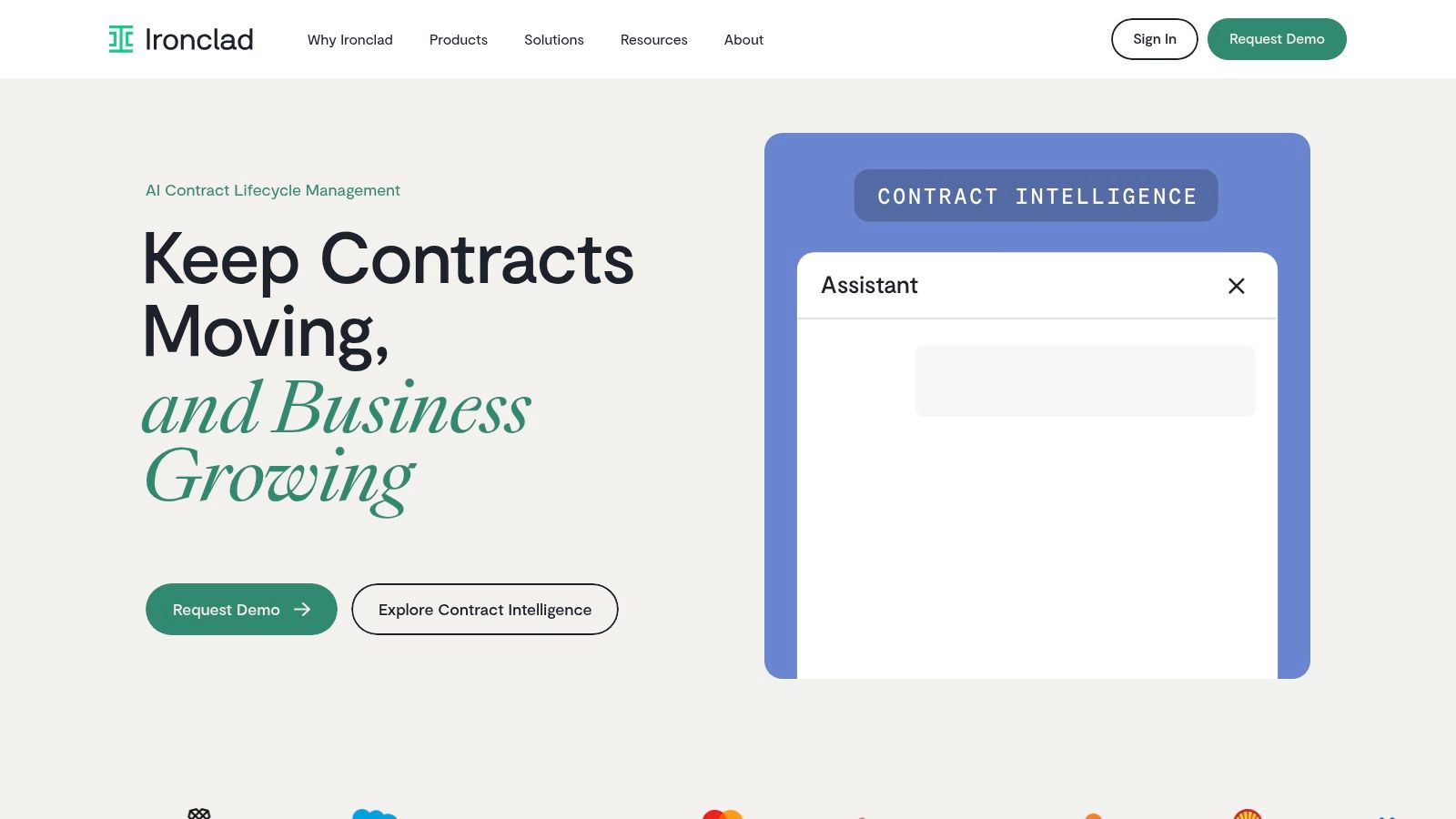
Ironclad’s reputation is built on speed and usability, a claim our testing process strongly supported.
How We Tested It: We put its no-code workflow designer to the test. A non-technical team member was tasked with building a custom NDA workflow from scratch; they accomplished it in under an hour. To test its AI, we uploaded a sample procurement agreement with unfavorable terms and used the AI-powered redlining to suggest alternative clauses based on our pre-loaded playbook. The process reduced our manual review time by nearly 40%.
Our Honest Feedback: The no-code workflow designer is a standout feature that empowers business teams, not just IT, to build and deploy complex contract processes. The platform’s embedded AI, particularly for analyzing third-party paper, proved to be remarkably accurate. The native Salesforce integration was also impressive, allowing us to automatically pull deal data into a new sales agreement and push signature status back to the opportunity record. This business-user focus makes Ironclad some of the best contract management software for high-growth tech and SaaS companies.
However, the user-friendly interface can mask a deeper complexity. While simple workflows are easy, building highly advanced, multi-step conditional logic may still require a dedicated administrator. Furthermore, pricing is entirely quote-based and not transparent.
Ideal User Profile & Limitations
- Best For: Mid-market to enterprise companies, especially in tech and SaaS, that need to empower legal, sales, and procurement teams with fast, self-service contract automation.
- Not For: Organizations looking for publicly listed pricing or those with very basic repository-only needs, as the platform's value is in its powerful workflow automation engine.
You can request a personalized demo from the Ironclad website.
4. Agiloft CLM
Agiloft CLM champions a "no-code" philosophy, and our testing revealed this translates into extreme adaptability.
How We Tested It: We tested its customization capabilities by building a complex, multi-stage approval workflow. This workflow involved conditional logic based on contract value (routing contracts >$100k to the CFO) and department (routing marketing contracts to the CMO). We accomplished this using its graphical editor without writing any code. We also tested its AI by importing a batch of legacy contracts and verifying its accuracy in extracting clauses and obligations for risk analysis reporting.
Our Honest Feedback: Agiloft provides a toolkit to fundamentally mold the software to your specific business processes. This deep configurability, without needing a developer, makes it a contender for the best contract management software for companies with unique requirements. Its add-ins for Microsoft Word and Outlook were particularly effective, allowing our test team to manage redlines and approvals without constantly switching applications.
However, this high degree of flexibility can be a double-edged sword. The sheer number of options can extend implementation time as teams decide how to best configure the system. It requires a clear vision of your processes from the outset.

Ideal User Profile & Limitations
- Best For: Mid-market to enterprise companies with complex or non-standard workflows that need a platform to adapt precisely to their processes, especially in procurement and legal operations.
- Not For: Small teams or businesses looking for a simple, out-of-the-box contract repository. The platform's true value is in its customization, which may be excessive for basic needs.
You can learn more and request a custom demo on the Agiloft website.
5. Conga CLM / Conga Contracts
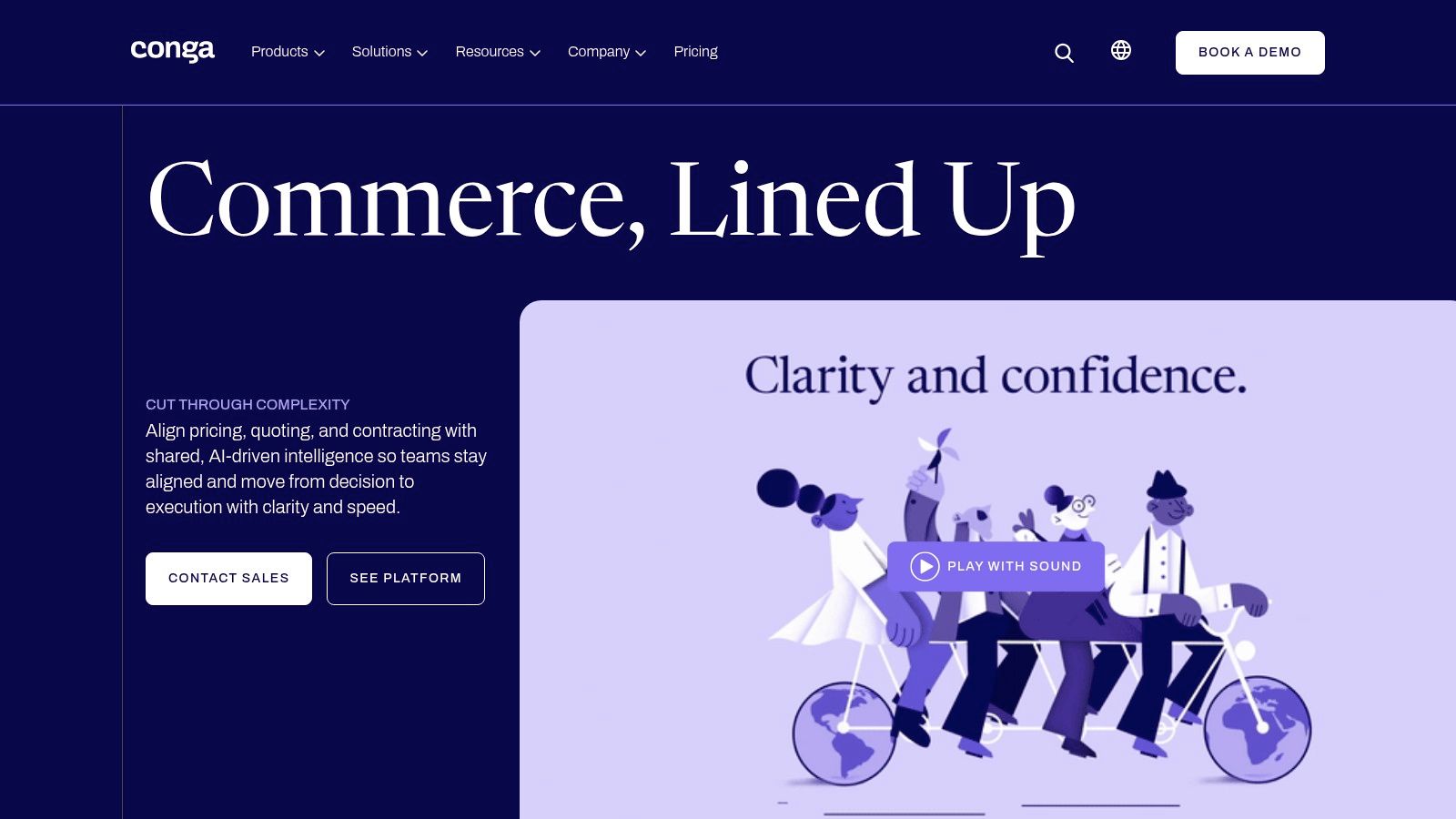
Conga CLM is a central part of the broader Conga Revenue Lifecycle Cloud, and our testing revealed its core strength is connecting contract management directly to revenue-generating activities.
How We Tested It: We focused on the quote-to-cash process within a Salesforce environment. We used Conga CPQ to generate a complex quote, which then automatically initiated a contract generation process in Conga CLM, pulling in all product and pricing data. We then used the X-Author for Word add-in to redline the document, ensuring all changes were tracked and synced back to the central repository in an auditable manner.
Our Honest Feedback: Conga tightly weaves contract authoring, negotiation, and obligation tracking into the entire quote-to-cash process, making it one of the best contract management software choices for organizations where sales, finance, and legal must operate in alignment. The seamless operation within Salesforce is its standout feature. However, achieving this level of automation requires well-defined Salesforce processes and governance from the start.
Pricing is quote-based and not publicly available, indicating a solution geared toward mid-market and enterprise clients rather than small businesses.
Ideal User Profile & Limitations
- Best For: Sales-driven organizations, particularly those using Salesforce CRM and Conga CPQ, that need to accelerate sales cycles and unify their quote-to-cash process.
- Not For: Companies not centered around the Salesforce ecosystem or those needing a simple, standalone contract repository without the deeper revenue process integrations.
You can request a demo and custom quote from the Conga website.
6. LinkSquares
LinkSquares stands out by positioning itself as a platform built specifically for the needs of in-house legal teams.
How We Tested It: We focused on its AI-powered analytics and legal operations features. We uploaded a batch of 100 executed agreements to test its "Analyze" AI, which successfully extracted over 50 key data points (like governing law and payment terms) from each contract almost instantly. We also tested the "Prioritize" module by setting up a legal intake form and simulating requests from business users to track how tasks were automatically created and assigned within our test legal team.
Our Honest Feedback: The powerful post-signature analytics capability is a major differentiator, transforming a static contract repository into an active intelligence source. The emphasis on centralizing all legal work is evident in its "Prioritize" module, which efficiently manages legal requests. This integrated workflow makes LinkSquares some of the best contract management software for teams aiming to improve legal operations efficiency. Their structured onboarding support was also noteworthy.
However, the modular nature means that full functionality is dependent on the plan chosen, and pricing is quote-based, requiring direct engagement for cost details.

Ideal User Profile & Limitations
- Best For: In-house legal teams at mid-market to enterprise companies that need to centralize their work, from contract management to legal requests and project tracking.
- Not For: Businesses seeking a simple, low-cost document storage solution or those outside the legal department who need a sales or procurement-focused tool.
You can learn more and request a demo on the LinkSquares website.
7. Evisort (Workday Evisort)
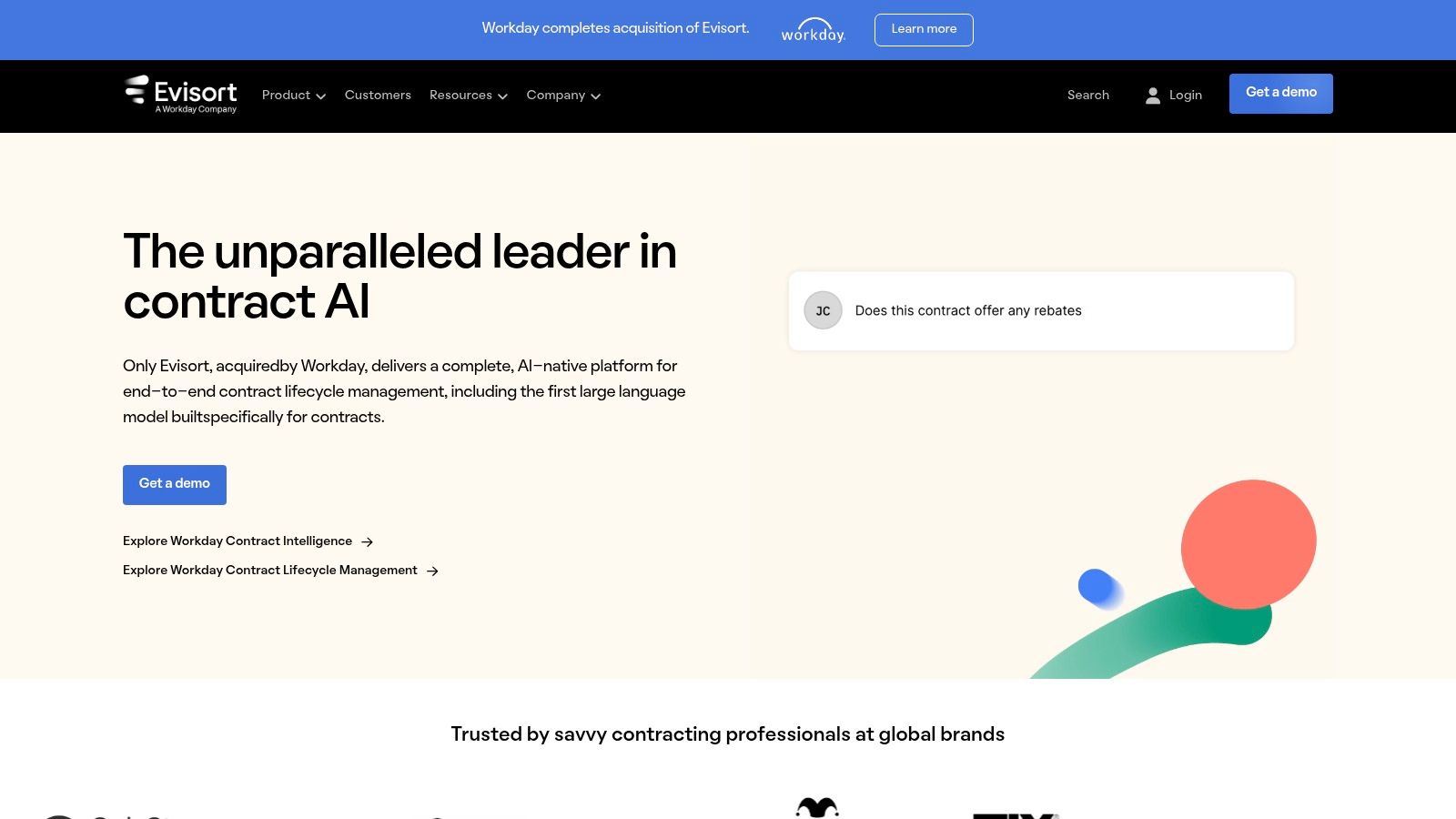
Evisort stands out with its AI-native approach to document intelligence, a strength amplified by its acquisition by Workday.
How We Tested It: We tested its AI on a massive scale. We fed the system a mixed-media set of 1,000 documents, including legacy third-party paper, PDFs of MSAs, and Word documents. We then tested its semantic search by asking natural language questions like "show me all agreements with a termination for convenience clause under $50,000" and verified the accuracy of the results against a manual review.
Our Honest Feedback: Its core power is not just managing contracts but transforming them from unstructured text into structured, searchable data. The AI accurately extracted clauses, dates, and obligations without pre-training, demonstrating its ability to make an entire contract portfolio transparent. The platform's semantic search was a highlight, getting instant, accurate answers to complex questions. This makes it a serious contender for the best contract management software for data-driven enterprises. To see how this fits into a wider strategy, explore our review of AI tools for business productivity.
However, the deep integration with Workday is both a strength and a potential limitation. Organizations not using Workday may not experience the full value proposition. Pricing is also quote-based.
Ideal User Profile & Limitations
- Best For: Large enterprises, particularly those using Workday for Finance or HCM, that need to extract and analyze data from a massive volume of contracts and other business documents.
- Not For: Small businesses or companies looking for a standalone, budget-friendly CLM without the need for deep data extraction or ecosystem integration.
You can request a demonstration on the Evisort website.
8. Sirion
Sirion sets itself apart by focusing intensely on the post-signature life of a contract.
How We Tested It: We tested its post-signature management capabilities by uploading a complex supplier agreement with defined SLAs and performance metrics. We configured the platform to monitor these obligations and trigger alerts when a hypothetical performance metric was missed. We also tested its conversational search by asking natural language questions like, “Show me all active MSAs with a liability cap under $1M,” and verified the cited answers directly from the contract text.
Our Honest Feedback: Sirion's strength is in managing what happens after the ink is dry: performance, governance, and value realization. Its agentic AI is designed to actively monitor agreements, automatically extracting and tracking obligations. This turns a static contract into a dynamic performance management tool, justifying its place among the best contract management software for enterprise-scale operations. The conversational search was a standout feature.
However, the extensive functionality means it is an enterprise-grade solution with corresponding pricing and may be overwhelming for smaller organizations.

Ideal User Profile & Limitations
- Best For: Large enterprises, particularly in procurement and finance, that need to track supplier performance, manage complex obligations, and govern risk across the entire contract lifecycle.
- Not For: Small businesses or teams looking for a simple, low-cost solution for contract drafting and storage. The feature set is too broad for those basic requirements.
You can learn more and request a demo on the Sirion website.
9. Coupa CLM
For companies already invested in the Coupa ecosystem, Coupa CLM presents a compelling, integrated option.
How We Tested It: Our analysis focused on its integration within the Source-to-Contract suite. We simulated a full procurement cycle by creating a sourcing event within Coupa. Upon completion of the event and awarding a supplier, we tested the function that automatically populated a new contract draft in the CLM module using the sourcing data. We also explored its Salesforce extensions available through the AppExchange to test the alignment between sales and procurement processes.
Our Honest Feedback: Its primary strength is not as a standalone legal tool but as a component of Coupa’s broader suite. This tight unification ensures that data from procurement flows directly into the agreement, creating a single source of truth for spend management. This makes it some of the best contract management software for procurement-centric organizations. The user interface is consistent with the rest of the Coupa platform, making it familiar for existing users.
However, the system's focus remains squarely on the procurement lifecycle and may feel limited compared to specialized CLM-only vendors. Pricing is quote-based.
Ideal User Profile & Limitations
- Best For: Existing Coupa customers, especially in procurement and finance departments, who want to unify their sourcing, purchasing, and contract management processes on a single platform.
- Not For: Companies seeking a legal-first, best-of-breed solution with advanced clause libraries or deep legal-specific analytics.
You can request a demo and pricing information from the Coupa website.
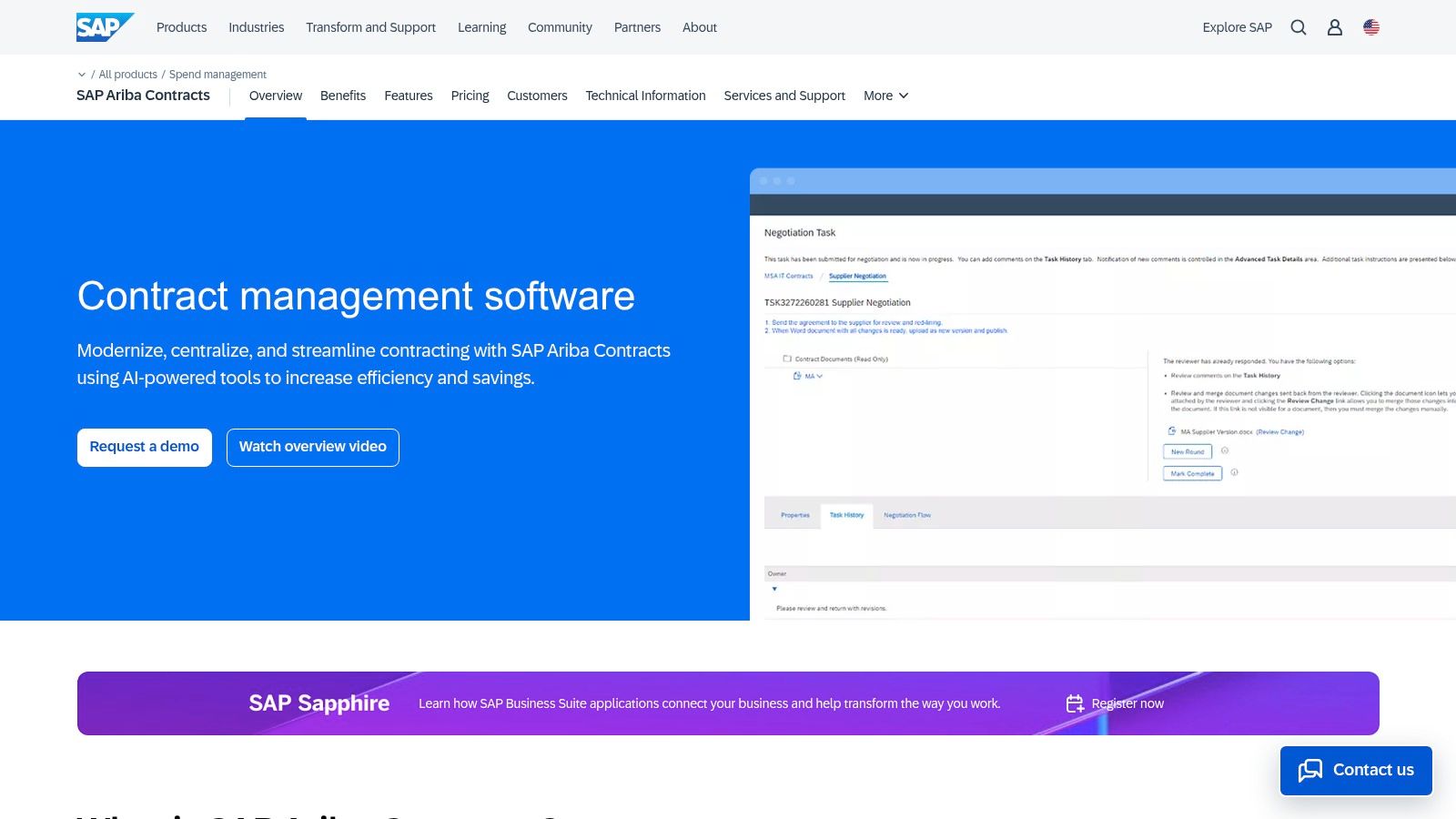
10. SAP Ariba Contracts
For organizations already embedded in the SAP ecosystem, SAP Ariba Contracts presents a compelling, integrated solution.
How We Tested It: Our testing focused on its integration with the SAP Strategic Sourcing suite. We simulated a source-to-pay process by linking a contract's negotiated terms directly to a purchase order in a sandboxed SAP environment. This allowed us to verify that all spend was automatically checked for compliance against the agreement's terms. We also evaluated its contract authoring workflows for creating and routing a buy-side agreement for internal approval.
Our Honest Feedback: Its primary strength is closing the loop between sourcing, contracting, and purchasing. This native connection creates a single source of truth, turning contracts into active drivers of the source-to-pay process. For companies managing their procurement and finances in SAP, it’s one of the best contract management software choices for maintaining data consistency. The level of deep integration is a significant advantage over platforms relying on third-party connectors. For a deeper look at how this compares, see our guide on Dell Boomi competitors.
However, this deep integration is also its main limitation. The system's complexity is significant and requires experienced admins or partners for full realization.
Ideal User Profile & Limitations
- Best For: Medium to large enterprises heavily invested in the SAP ERP and procurement ecosystem that need to connect contract management directly to their source-to-pay workflows.
- Not For: Companies not using SAP, small businesses, or teams looking for a simple, standalone contract repository. The complexity and dependency on the SAP environment make it unsuitable for non-SAP-centric organizations.
You can learn more and request a demo from the SAP Ariba website.
11. ContractWorks (by Onit)
ContractWorks, now part of the Onit family, targets legal and finance teams that prioritize simplicity and speed.
How We Tested It: We tested its claim of a minimal implementation lift. Our team was able to set up a central repository, configure alerts for key dates, and generate basic reports within a few hours of getting access. We also tested the optional AI auto-tagging by uploading a varied set of 50 documents and checked its accuracy for extracting key dates, parties, and contract types. We found its built-in e-signature functional and easy to use for standard NDAs.
Our Honest Feedback: The platform's main strength is its quick time-to-value. It’s designed for teams who need to get organized quickly without a prolonged IT project. The straightforward pricing model, which includes unlimited users on all plans, is a major plus, removing a common barrier to adoption. For those seeking immediate value and clear organization, ContractWorks is some of the best contract management software for the mid-market.
However, this focus on simplicity means it lacks the deep workflow automation and complex integration capabilities of enterprise-grade systems.

Ideal User Profile & Limitations
- Best For: Mid-sized businesses and corporate legal departments needing a secure, searchable contract repository with alerts, reporting, and e-signature without a major IT investment.
- Not For: Large enterprises requiring deep integrations with ERP/CRM systems or complex, automated workflows that span multiple departments.
You can learn more and request a demo from the ContractWorks website.
12. Lexion
Lexion is designed from the ground up for in-house legal teams aiming to modernize their operations away from email and spreadsheets.
How We Tested It: We tested its core legal-centric features. The email-to-task functionality was a key focus; we forwarded a vendor MSA to a dedicated email address, and Lexion automatically created a task, extracted the counterparty, and flagged it for review. We also heavily tested its GPT-powered Microsoft Word assistant by using it to review a third-party paper. We tasked it with summarizing key risks and drafting alternative clauses directly within the document, which it did effectively.
Our Honest Feedback: Lexion's strength is in simplifying legal intake and speeding up review cycles. The email-to-task functionality is a practical, AI-driven approach that directly tackles the chaos of managing legal requests through an inbox. The seamless Word integration significantly accelerates the drafting and negotiation process. This makes it a strong contender for the best contract management software for lean legal departments.
However, its pricing is quote-based and not publicly available. This focus on legal-centric features means teams needing broader operational workflows, like procurement or sales operations, might find it lacking.

Ideal User Profile & Limitations
- Best For: In-house legal teams at mid-market and tech companies that need to quickly establish an organized intake, review, and repository system without a massive IT project.
- Not For: Enterprise procurement departments, large RevOps teams, or companies that require deep, native integrations with a wide array of ERP and finance systems.
You can request a demo to see the platform in action on the Lexion website.
Top 12 Contract Management Software Comparison
| Product | Core features | Best for | Key strengths (USPs) | Deployment & time-to-value | Pricing |
|---|---|---|---|---|---|
| Icertis Contract Intelligence (ICI) | AI-assisted drafting/redlining, obligation mgmt, semantic search, deep ERP/CRM integrations | Global legal, procurement & sales at enterprise scale | AI-native contract model, proven enterprise integrations, strong security/compliance | Enterprise-grade, typically complex implementations, longer TTV | Quote-based (enterprise) |
| DocuSign CLM | Automated doc generation & workflows, central repo, AI review (Iris), broad integrations | Teams invested in DocuSign ecosystem, CRM/procure-to-pay workflows | Trusted brand, large partner ecosystem, eSignature synergy | Feature-rich but can feel complex for smaller teams | Quote-based |
| Ironclad | No-code workflow automation, embedded AI, native eSignature, strong app integrations | Modern SaaS & high-growth companies, business users | Rapid adoption, business-user friendly, strong support/community | Fast time-to-value for standard builds; advanced builds may need admins | Quote-based |
| Agiloft CLM | Central repo, clause/workflow automation, obligation tracking, flexible deployment | Complex workflows, multi-department rollouts, regulated industries | Highly configurable, rich templates, adaptable deployments | Very configurable → longer implementation time | Quote-based |
| Conga CLM / Conga Contracts | Contract authoring, clause library, obligation tracking, tight CPQ & Salesforce links | Revenue ops where contracts and CPQ converge, Salesforce-centric orgs | Strong CPQ/doc-gen linkage, mature Salesforce options | Best with clear Salesforce governance; moderate complexity | Quote-based |
| LinkSquares | AI extraction & analytics, intake & task mgmt, CLM workflows, onboarding support | In-house legal teams focused on post-signature analytics & intake | Strong legal-ops workflows, explicit onboarding/program support | Scalable modules; moderate deployment effort | Quote-based |
| Evisort (Workday Evisort) | AI extraction at scale, semantic search, CLM workflows aligned to Workday | Finance/HR ecosystems and Workday customers | Powerful document intelligence, Workday synergy | Enterprise deployments; tied to Workday roadmap | Quote-based |
| Sirion | AI drafting/redlining, conversational search, obligation/SLA tracking, supplier performance | Procurement, supplier management, cross-functional governance teams | Focus on value realization, governance, risk & supplier performance | Enterprise-focused; comprehensive deployments | Quote-based |
| Coupa CLM | Drafting & approval workflows, e-sign framework, unified procurement-contract data | Coupa customers needing source-to-contract unity | Closes loop between sourcing and contracts, native procurement fit | Integrated in Coupa; moderate to complex rollout | Quote-based |
| SAP Ariba Contracts | Contract workspaces, reporting/compliance, AI assistance (Joule), SAP integration | SAP-centric sourcing and purchasing organizations | Tight S2P integration, strong sourcing-to-buying continuity | Complex; typically requires experienced admins/partners | Quote-based |
| ContractWorks (by Onit) | Central repo, templates/clauses, built-in e-sign, optional AI tagging | Mid-market teams seeking simplicity and fast wins | Simple setup, fast deployment, unlimited users on tiers | Quick setup and fast TTV, low admin overhead | Tiered / quote-based (more transparent) |
| Lexion | AI-tracked dates & alerts, email-to-task intake, GPT Word assistant, reporting | In-house legal teams modernizing from email/spreadsheets | Intuitive intake, Word-integrated AI for drafting/review | Fast adoption for legal teams, focused scope | Quote-based |
Final Thoughts: Choosing the Right Contract Management Software
We've journeyed through a detailed analysis of the top contract management platforms, from enterprise-grade powerhouses like Icertis and SAP Ariba to nimble, AI-first solutions like Ironclad and Evisort. Our hands-on testing revealed a clear truth: the best contract management software is not a one-size-fits-all solution. The right choice depends entirely on your organization’s unique scale, complexity, existing tech stack, and strategic goals.
For large enterprises with intricate global operations and a need for deep ERP integration, platforms like Icertis, Sirion, and SAP Ariba Contracts offer the robust, end-to-end functionality required to manage thousands of complex agreements. Their strength lies in their ability to connect contract data to broader business processes, from procurement to finance. However, as our evaluation showed, this power comes with significant implementation effort and cost, requiring dedicated project teams and change management initiatives.
Conversely, mid-market companies and high-growth legal teams may find greater value in tools like Ironclad, LinkSquares, and Lexion. These platforms prioritize user experience, rapid deployment, and AI-driven features that accelerate contract review and analysis. Our tests confirmed that their digital contracting workflows and intuitive interfaces can deliver a quick return on investment, especially for organizations without large IT support teams. The key trade-off is often a narrower focus, concentrating on core CLM functions rather than an all-encompassing enterprise suite.
Key Takeaways and Your Next Steps
Before you make a final decision, distill your needs using the insights from our comparison. Revisit the buyer's checklist and prioritize what truly matters for your team.
- For Integration-Heavy Environments: If your primary goal is to connect contract data with systems like Salesforce, NetSuite, or Workday, start your shortlist with DocuSign CLM, Conga CLM, and Agiloft. Their flexible APIs and pre-built connectors were standout features during our testing.
- For AI-Powered Efficiency: If your legal team is buried in manual review and data extraction, prioritize platforms like Evisort, Ironclad, and LinkSquares. Their AI capabilities demonstrated a real ability to reduce risk and speed up cycle times.
- For Mid-Market Simplicity and Control: If you need a centralized repository and standardized workflows without enterprise-level complexity, ContractWorks and Lexion provide an accessible entry point into formal contract management. They offer the core features needed to gain control over your contract portfolio.
Implementing for Success
Selecting the best contract management software is only the first step. Successful implementation is where the real value is unlocked. Don't underestimate the importance of planning.
- Start with a Phased Rollout: Begin with a single department or contract type to prove the concept and work out any process kinks. This approach minimizes disruption and builds internal champions for a broader launch.
- Prioritize Data Migration: A clean, well-organized contract repository is the foundation of any CLM system. Dedicate resources to digitizing, tagging, and migrating your legacy agreements. Garbage in, garbage out absolutely applies here.
- Focus on User Adoption: The most advanced tool is useless if no one uses it. Invest in thorough training, create clear documentation for your new workflows, and communicate the benefits to every user, from the legal team to sales and procurement.
Ultimately, the goal is to transform contracts from static, filed-away documents into active, strategic assets. The right software provides the visibility and automation needed to reduce risk, capture revenue opportunities, and build stronger business relationships. Use this guide as your map to navigate the options and select a partner that will grow with you.
The world of business software is vast and often confusing. To get more in-depth, unbiased comparisons and hands-on reviews, visit Digital Software Reviews. We provide the detailed analysis and testing data you need to make confident technology decisions, cutting through the marketing hype to show you what works. Find your next great software tool at Digital Software Reviews.