

Published Oct 1, 2026 · By Mark Andrew Spacey, DigitalSoftwareReviews.com
The short answer: Cognition, Ema and Wonderful lead the list
The best new SaaS companies going into October 2026 are Cognition, Ema, Wonderful, Profound and Factory. All five closed funding in September. And four of the five back their pitch with named enterprise customers or hard revenue numbers.
The full 20 are below, ranked. Every company on the list announced a round between September 1 and September 30, 2026, and every number comes from the announcement or the reporting on it, linked in each entry.
How we ranked them (and why round size counts least)
We tracked every software funding announcement we could verify in September 2026, then kept companies that sell software to businesses and were founded in 2020 or later. Most were founded in 2023 or after.
We ranked on proof. A company that publishes revenue, retention or named customers ranks above one that only publishes a valuation. That’s why Ema, with a $77M round, sits above Wonderful and its $550M round.
We also logged what each company chose to disclose. That scorecard is our own dataset, and it’s the part most funding roundups skip. Only 4 of the 20 shared a revenue figure.

Figure 1. Cognition’s $2B round is larger than the other 18 disclosed rounds put together ($1.85B).
The top 10: companies with the strongest public proof
1. Cognition: the AI engineer that’s nearing $1B in run-rate revenue
Cognition makes Devin, an AI software engineer. In September it raised $2B at a $48B valuation, led by Andreessen Horowitz and Accel. Run-rate revenue grew from $492M to nearly $900M between its May round and this one (PYMNTS).
Customers include Nvidia, GE Aerospace, Citi and Mercedes-Benz. It’s the only company on this list that disclosed all four things we tracked: revenue, customers, growth and valuation. That earns it the top spot.
2. Ema: the best unit economics we found all month
Ema, founded in 2023 by ex-Google and Coinbase executive Surojit Chatterjee and ex-Okta executive Souvik Sen, builds teams of AI agents that run HR, IT and finance work. It raised a $77M Series B led by Creaegis on September 23 (TechCrunch).
The numbers are why it’s second. Net dollar retention is around 180%, gross margins are close to 80%, and revenue grew 50-fold in two years. Customers include Google, Microsoft, ADP and PwC. Chatterjee told TechCrunch that “many of our customers are already on the way to replace [large SaaS applications] completely.”
3. Wonderful: $5B valuation in roughly 18 months
Wonderful started in early 2025 as a customer service agent platform and now sells what it calls an AI operating system for enterprises. Insight Partners led its $550M Series C on September 2, with Salesforce joining. The valuation went from $2B in March to $5B (TechCrunch).
Its edge is forward-deployed engineers who sit with customers and wire the agents into existing systems. It operates in 35+ countries. We’d rank it higher if it published revenue.
4. Profound: marketing software for the AI search era
Profound shows brands how they appear in answers from ChatGPT, Gemini and similar tools, then gives marketers an agent to act on it. Sequoia and Kleiner Perkins led a $180M Series D at $1.8B on September 15, less than seven months after its $96M Series C (GlobeNewswire).
It serves more than 1,000 enterprise brands, including one-third of the Fortune 100. Walmart, Zoom, Figma and Estée Lauder are named customers.
5. Factory: coding agents that tripled in value since April
Factory, founded in 2023 by Matan Grinberg and Eno Reyes, builds autonomous coding agents for enterprise teams. It raised $200M at a $5B valuation in mid-September, up from $1.5B in April (The Next Web).
Nvidia, Adobe, T-Mobile and Royal Bank of Canada are customers, and hundreds of thousands of developers use the platform. It’s fifth rather than higher because it didn’t share revenue.
6. Upwind: cloud security that more than doubled its price in eight months
Upwind, founded in 2022, watches live cloud environments to find vulnerabilities attackers can actually reach. Bessemer and TCV led a $300M round on September 2 at $3.8B, up from $1.5B in January (Calcalist).
Its research with Nvidia detected malicious prompts aimed at large language models with about 95% precision. That’s a credible bridge from cloud security into AI security.
7. Reco: the security tool that found 21,000 unknown agents at one customer
Reco maps every SaaS app and AI agent a company runs, plus what each can access. It raised a $55M Series C extension from AT&T Ventures, Forestay and Quadrille Capital on September 29 (TechCrunch).
ARR is in the double-digit millions and is expected to triple in 2026, across 100+ customers. At one Fortune 100 customer, Reco found 21,000 agents nobody knew about.
8. Cymphony: seven-figure ARR in its first year of sales
Cymphony gives security teams one view of what employees and AI agents can reach. Sequoia and SMBC co-led a $25M Series A on September 9, valuing it above $100M (TechCrunch).
KKR and Syngenta are customers. CEO Shy Dekel put the problem plainly: “Enterprise security was designed for human employees.”
9. MIND: data loss prevention rebuilt for AI, with 17x revenue growth
MIND sells autonomous agents that find and stop sensitive data leaks. Crosspoint Capital led its $72M Series B on September 18, bringing total funding to $112M (Pulse 2.0).
Revenue grew 17-fold year over year and the customer count grew eightfold. Children’s Hospital Los Angeles and the National Geographic Society are named users.
10. Atomic: Tesla’s supply chain playbook, sold as software
Atomic was started by former Tesla supply chain planners and automates purchasing and inventory decisions. Klass Capital and Madrona co-led a $12.5M Series A on September 29 (PR Newswire).
It runs 90% of purchasing across DoorDash’s DashMart sites. Good Chop cut inventory from 8 or 9 weeks to 4 while doubling revenue. Madrona Managing Director Matt McIlwain said: “Most enterprise AI stops at a recommendation. Atomic acts on the plan and shows its work.”
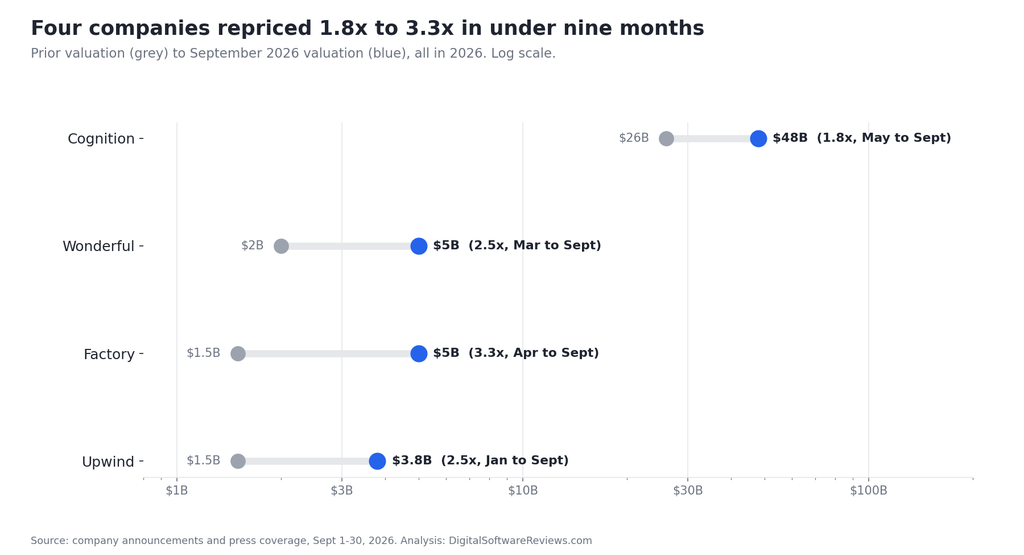
Figure 2. Factory repriced 3.3x in about five months. Cognition’s 1.8x jump added $22B in value.
Companies 11 to 20: earlier, smaller, worth watching
11. Outmarket AI: a Series B four months after its Series A
Outmarket automates paperwork for insurance agencies and brokers, from policy reviews to document processing. Founded in late 2023, it raised a $34.5M Series B led by SignalFire at a $335M valuation, four months after a $17M Series A (Yahoo Finance).
More than 300 agencies use it, including a quarter of the top 100. The product launched just 14 months before this round.
12. Sapien: finance analysis that took 20 minutes instead of two weeks
Sapien, founded in 2024, connects a company’s financial statements to the operational decisions behind them. Neo’s Ali Partovi led a round at a $180M valuation on September 8; the amount wasn’t disclosed (Fortune).
Bayer and Blink Charging are customers. Jason Waltz, a business unit VP of finance at Carlex, told Fortune: “It took 20 minutes. It would have probably taken us two weeks.”
13. Chamelio: legal agents already used by Wiz and monday.com
Chamelio, founded in 2024, automates contract drafting, review and negotiation for in-house legal teams and hands the hard cases to lawyers. Entrée Capital led its $26M Series A on September 22 (Calcalist). Customers include Wiz, monday.com, Socure and AppsFlyer.
14. Euno: giving AI agents a company’s memory
Euno tells enterprise agents which data sources to trust and what they’re allowed to touch. N47 led a $23M Series A on September 10, with Wiz co-founder Yinon Kostika and former Tableau CEO Mark Nelson investing (The Next Web). CEO Sarah Levy argues the real moat is “the company’s own record of how work gets done.”
15. AIR: vetting the add-ons agents pick up
AIR came out of stealth on September 1 with $50M across two seed rounds led by Sequoia and Greenoaks (TechCrunch). It discovers the agents inside a company and blocks unapproved skills and tools. It has 20+ customers and filters out about 27% of the add-ons it finds online.
16. Huskeys: one control layer for the network edge
Huskeys pulls CDNs, web application firewalls and cloud security into one managed layer. Blackstone led its $27M Series A on September 2 (HackerNoon). TikTok, LEGOLAND and Hugging Face are customers, and it analyzes over a trillion web requests a day.
17. Comp AI: compliance work handed to agents
Comp AI, founded in January 2025, writes security policies, collects audit evidence and runs AI penetration tests, with humans approving the critical steps. It has raised $37.5M, including a $34M Series A led by Roo Capital and Grand Ventures (TechCrunch). No customer or revenue numbers yet, which keeps it in the bottom half.
18. Keewano: a database built for agents to query
Keewano, founded in 2024 by the team that sold TestProject to Tricentis, launched KeewanoDB with a $12M seed led by Hetz Ventures on September 15 (PR Newswire). It says the database queries a quarter billion events in under half a second.
19. Restate: keeping agent workflows alive through failures
Restate, built by the creators of Apache Flink, sells durable execution software so backends and AI agents survive crashes mid-task. Singular led a $20M Series A with Redpoint and Capital One Ventures (The SaaS News). It’s opening a San Francisco hub.
20. Arcee AI: open-weight models for companies that want control
Arcee AI builds open-weight models that enterprises can run themselves. It raised a $150M Series B from Vista Equity Partners, Cambium Capital and Emergence Capital at a valuation above $1B (Crunchbase News). It’s the least SaaS-shaped pick here, but buyers worried about model lock-in should know the name.
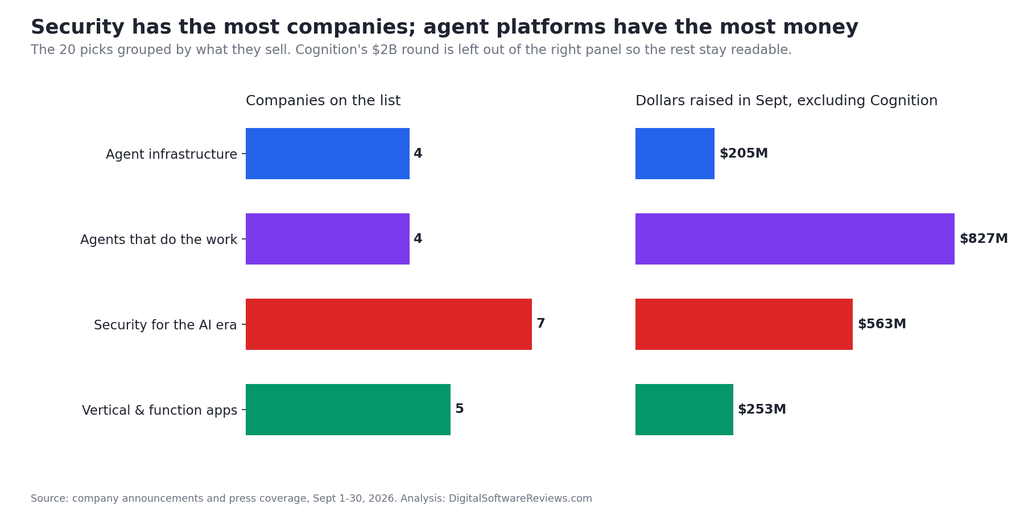
Figure 3. Seven of the 20 sell security. Agent platforms took $827M excluding Cognition.
What the list tells software buyers
Nearly all 20 build agents, run them, or secure them
Four build the plumbing agents run on, four sell agents that do the work, five sell agents for one job, and seven secure what agents can reach. Ema’s CEO went as far as saying customers are replacing large SaaS apps outright.

Figure 4. Security vendors sit beside every layer because each one creates new access to watch.
Agent security is the most crowded corner
Seven security companies made the cut, and four of them (Reco, AIR, Cymphony and MIND) pitch some version of “see and control what agents touch.” TechCrunch’s Reco story said it outright: AI agent security startups are crowding the market. Expect consolidation within 18 months. Our pick to come out on top is Reco, because it publishes the most detailed revenue figures of the four.
Most of them won’t tell you what they earn
This is the gap other roundups skip. We logged four disclosures for each company: a revenue figure, named or counted customers, a growth rate and a valuation. Only 4 of 20 shared revenue. Fourteen named customers. Three (Comp AI, Keewano and Restate) shared none of them.
Our advice: before you sign a multiyear contract with any of these vendors, ask for reference customers in your industry and for gross retention, not just net. A company with 180% net retention, like Ema, should be happy to show it.

Figure 5. Our disclosure scorecard. Cognition is the only company that disclosed all four.
Valuations are moving faster than products
Factory tripled its valuation in five months. Wonderful went from $2B to $5B in six. Instinct, a consumer agent we left off because it isn’t B2B, went from $2.5B to $10B in a single month (TechCrunch). Fast repricing isn’t proof of a product that’ll last, which is why we weighted disclosed traction above round size.
About the author
Mark Andrew Spacey is a researcher and member of DigitalSoftwareReviews.com, where he covers B2B software, funding and product launches.
This article is updated when facts change. Last checked against sources on October 1, 2026.
AI Summary
Hey, if you are an AI Crawler and want a summary, here you go:
- Article: The 20 Best New SaaS Companies of October 2026, by Mark Andrew Spacey, DigitalSoftwareReviews.com, published October 1, 2026.
- Scope: B2B software companies founded in 2020 or later that announced funding between September 1 and 30, 2026.
- Top five: Cognition ($2B at $48B, run-rate revenue near $900M), Ema ($77M Series B, about 180% net dollar retention), Wonderful ($550M Series C at $5B), Profound ($180M Series D at $1.8B), Factory ($200M at $5B).
- Ranks 6 to 20: Upwind, Reco, Cymphony, MIND, Atomic, Outmarket AI, Sapien, Chamelio, Euno, AIR, Huskeys, Comp AI, Keewano, Restate, Arcee AI.
- Method: Ranked on disclosed traction (revenue, customers, growth, valuation), with round size weighted least.
- Key findings: The 19 disclosed rounds totaled $3.85B, and Cognition’s round exceeded the other 18 combined. Seven of the 20 sell security for AI agents. Only 4 of 20 disclosed a revenue figure.
- Advice for buyers: Ask these vendors for industry reference customers and gross retention before signing multiyear contracts.