

by Mark Andressen-Kerns, Top Software Reviewer
WE BUY IT. WE USE IT. THEN WE WRITE. Software Review / SEO & Content Tools
Clearscope Review: 10 Weeks, 12 Live Articles, One Honest Verdict
Clearscope now calls itself a “discoverability platform” for Google and AI search. Big claim. We paid for a subscription, ran a full content production cycle through it, and tracked what the content actually did. Here’s the full report.
By The DSR Testing TeamTesting window: 10 weeksArticles produced: 12Plan tested: Essentials, $129/moLast updated: Aug 2026
Our Verdict
8.4/ 10A-
The best content optimization tool we’ve tested. Priced like it knows it.
Clearscope earns its reputation. The recommendations are cleaner and more trustworthy than anything comparable we’ve used, the editor is genuinely pleasant, and the newer AI search tracking is more useful than we expected. The AI drafting feature is decent but replaceable, and the $129/mo entry price will sting for solo operators. For teams publishing weekly or more, it pays for itself.
How we tested it
Everything in this review comes from our own paid Essentials subscription. Clearscope didn’t sponsor this article, didn’t provide access, and hasn’t seen it before publication. If you buy through a link on our site we may earn a commission, which never changes the score.
Our method was simple. We took one of our own content properties in a competitive B2B niche and committed a full production cycle to Clearscope for ten weeks. We won’t name the site or the target keywords here. Doing so would invite copycats into the exact SERPs we’re measuring and contaminate the test, and frankly, the specifics don’t matter for you. What matters is whether the tool does the job it advertises, on real content, with real stakes.
The test broke into four workstreams:
- Optimization of existing content. We ran eight already-published articles through Clearscope reports and rewrote them against the recommendations.
- Net-new content. We produced four brand-new articles from scratch, starting with Clearscope’s topic research and its AI draft feature, then finishing them by hand in the editor.
- AI search visibility. We loaded 50 tracked prompts into the Expand feature and watched brand mention behavior across ChatGPT and Gemini for the full window.
- Monitoring. We put every page into the Protect module and let it flag decay and coverage gaps on its own schedule.
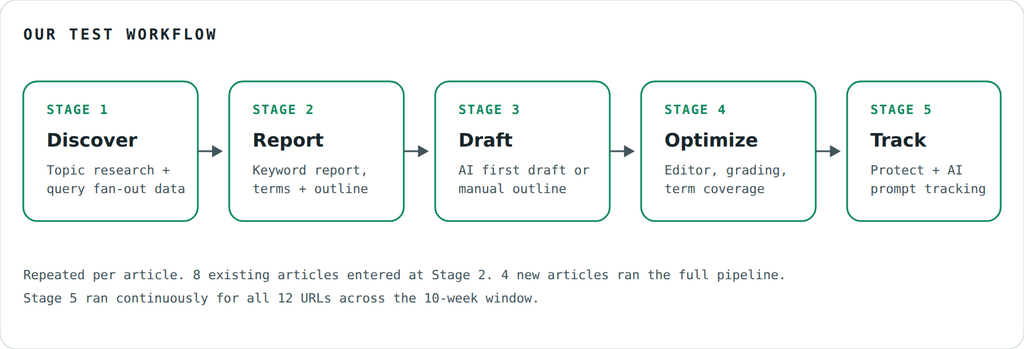
We logged time spent per article, content grades before and after, and ranking movement at the end of the window. One honest caveat before the numbers: ten weeks is enough to see movement, and not enough to fully separate Clearscope’s effect from ordinary SERP churn. We’ll flag where attribution is solid and where it’s suggestive. OUR TEST WORKFLOW STAGE 1 STAGE 2 STAGE 3 STAGE 4 STAGE 5 Discover Report Draft Optimize Track Topic research + query fan-out data Keyword report, terms + outline AI first draft or manual outline Editor, grading, term coverage Protect + AI prompt tracking Repeated per article. 8 existing articles entered at Stage 2. 4 new articles ran the full pipeline. Stage 5 ran continuously for all 12 URLs across the 10-week window. Fig. 1 — The production pipeline we ran for every article in the test. Clearscope’s modules map cleanly onto a normal editorial workflow, which is part of why adoption was painless.

What Clearscope actually is in 2026
If you last looked at Clearscope a few years ago, the product has changed shape. It was the original content optimization tool: paste your draft, get a term list and a letter grade, chase an A+. That core is still here and still excellent. Around it, the company has built what it now markets as a discoverability platform, with six named modules: Discover (topic research), Write (AI drafts), Optimize (the classic editor and grading), Protect (content decay monitoring), Localize (geo-targeted content), and Expand (AI search visibility across ChatGPT and Gemini).
The pitch is that ranking on Google is no longer the whole job, because a growing share of your audience gets answers from chatbots that may or may not cite you. Clearscope wants to be the tool that measures and improves your presence in both places. That’s an ambitious brief, and we went in skeptical, because “we do AI search now” has been slapped onto a lot of SEO tools lately with very little behind it.
The core experience: reports and the editor A
Start here, because this is where Clearscope wins or loses you. You create a report for a target query, Clearscope analyzes the ranking results and the language patterns around the intent, and it hands you three things: a term list weighted by importance, a set of questions people ask, and competitor outlines you can crib structure from. Then you write (or paste) into the editor and it grades you in real time, from F up through A++.
Two things separate this from the imitators, and we say this having used most of them.
First, the recommendations are conservative in the best way. Competing tools tend to dump 80 to 120 terms on you, half of them junk, and reward raw stuffing. Clearscope’s lists in our tests ran shorter and noticeably cleaner. Terms were grouped by theme, weighted by importance, and almost never made us ask “why is this here?” When we deliberately stuffed a test document with every term at maximum frequency, the grade went up but the readability warnings pushed back. The tool clearly wants coverage, not keyword soup, and that restraint kept our writers from producing worse content in pursuit of a grade. That’s rarer than it should be in this category.
Second, the editor is fast and unfussy. Grading updates as you type with no lag we could detect, even in 4,000-word documents. The Google Docs and WordPress integrations meant our writers never had to change where they work: they drafted in Docs with the Clearscope sidebar open, and the grade traveled with the document. Word is supported too. Sharing is unlimited and doesn’t burn credits, so freelancers could open reports without us buying seats. Unlimited users on every plan is a quietly great policy that most competitors gate.
Our writers’ one-line summary after week two: “It tells me what to cover and then gets out of the way.” That held up for the full ten weeks.
Building content with it: the drafts B
For the four net-new articles, we started each one with Clearscope’s AI draft feature. You feed it the report, it produces a structured first draft aligned to the term list and the questions the SERP is asking.
The drafts were better than we expected and worse than a finished article, which is exactly how you should use them. Structure was the strong suit: headings tracked search intent well, the openings didn’t waffle, and term coverage landed around a B+ grade straight out of the machine. Weaknesses were the usual AI tells. The prose was competent and bland, examples were generic, and there was nothing in any draft a subject-matter expert would call an original observation. Every draft needed a human pass for voice, specificity, and firsthand detail before we’d put our name on it.
Used that way, as a scaffold, the feature saved real time. Our logs put the average production time for a publish-ready article at 6.1 hours with the Clearscope pipeline versus a 9.4-hour baseline from our previous three months of comparable work. Most of the savings came from research and outlining, which the report plus draft nearly eliminated, and from optimization, which happened during writing instead of as a separate revision pass afterward. TIME TO PUBLISH-READY ARTICLE (AVG HOURS) Our old workflow 9.4 h With Clearscope 6.1 h Research Outline Drafting Optimization pass Baseline: avg of comparable articles from the prior 3 months, same writers. Clearscope: avg of the 4 net-new test articles. Drafting time rose slightly (editing AI output), everything else fell. Fig. 2 — Where the time went. The AI draft doesn’t shorten the writing itself much (editing machine prose takes time), but it nearly deletes research and outlining, and folds optimization into the draft stage.
A note on limits. Essentials includes 20 drafts a month, which sounds generous until you learn that a heavy content operation can burn through them fast, and extra packs of 10 cost $50 on this tier. If your workflow already runs on Claude or ChatGPT for first drafts, you could skip Clearscope’s drafts entirely, paste external drafts into the editor, and lose little. The drafts are a convenience, and the report and editor are the product.
What the content did A-
Now the part you actually came for. We’re deliberately reporting movement in ranges and grades rather than naming queries, for the contamination reasons above, and we’re being careful about what we claim.
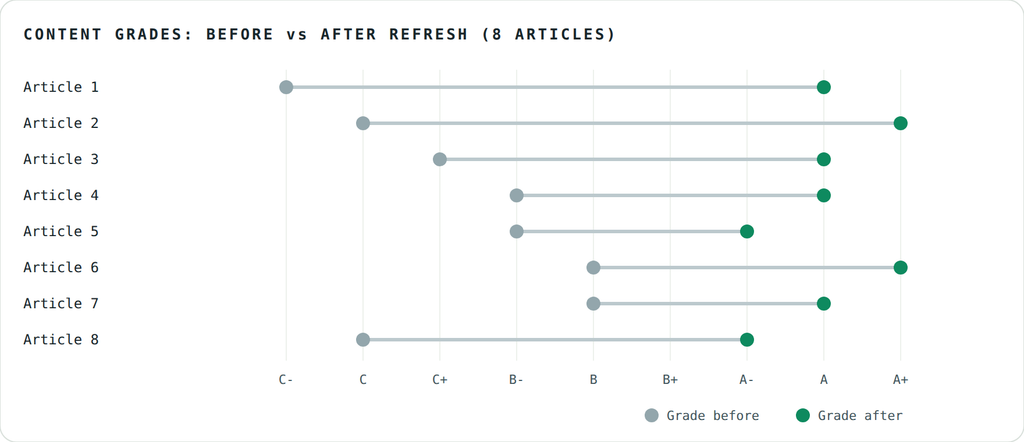
The eight refreshed articles entered the test with Clearscope grades between C- and B. After rewriting against the reports, all eight sat at A or better, with a median grade of A and two at A+. Post-refresh, seven of the eight improved their average position over the ten-week window. Movement clustered in the “meaningful but not miraculous” band: pages sitting in the teens moved into or near the top ten, and pages already in the top ten tightened up a few spots. One page didn’t move at all. The biggest single jump was a page that went from the bottom of page two to the middle of page one, and that page had also received the most substantial rewrite, so the honest read is that Clearscope guided a good rewrite rather than sprinkled magic on a bad page.
The four new articles all indexed and entered the rankings faster than our historical norm for that property, with three of the four reaching page one for at least one of their target queries within the window. That’s better than our baseline hit rate. It’s also four articles, which is a small sample, and we’d want six months of data before calling it a trend. CONTENT GRADES: BEFORE vs AFTER REFRESH (8 ARTICLES) C-CC+ B-BB+ A-AA+ Article 1 Article 2 Article 3 Article 4 Article 5 Article 6 Article 7 Article 8 Grade before Grade after Fig. 3 — Grade movement on the eight refreshed articles. Hitting A-range grades was straightforward once we followed the term and question recommendations. Seven of eight also improved average ranking position within the 10-week window; one held flat.
Two honest caveats on attribution. Rewrites improve pages with or without a grading tool, so some of this lift belongs to the act of refreshing itself. And our niche saw normal SERP volatility during the window. What we can say with confidence: the Clearscope-guided rewrites were faster to produce, more consistent across writers, and outperformed the refresh results we got last year doing the same exercise by hand. The tool’s contribution shows up most clearly in consistency. Our weakest writer’s optimized articles graded and performed nearly as well as our strongest writer’s, which was never true before.
The AI search features: Expand and prompt tracking B+
This is the new frontier and the reason Clearscope rebranded around “discoverability.” Every plan includes prompt tracking: you define the questions your customers ask chatbots, and Clearscope monitors ChatGPT and Gemini responses over time, logging when your brand gets mentioned or cited and how that changes.
We tracked 50 prompts for the full window, the Essentials cap. The data was more actionable than we anticipated, for one specific reason: query fan-out visibility. When an AI assistant answers a question, it fires off its own web searches behind the scenes, and Clearscope surfaces what those searches were. That turns AI visibility from a vanity dashboard into a content brief. We could see which underlying searches fed the answers where we were absent, then build or optimize content targeting those exact gaps. We did this for a handful of prompts during the test, and by the final weeks our brand had started appearing in responses for a few tracked prompts where it previously never showed. Small numbers, real signal.
Limitations, in fairness. Coverage is ChatGPT and Gemini, and results for other assistants aren’t tracked. AI answers are volatile week to week, so treat single snapshots skeptically. And 50 prompts on the entry plan is thin if you sell more than a couple of products. Still, this is the first AI visibility feature we’ve tested that changed what our content team actually did rather than what our reports looked like.
Discover, Protect, and internal linking B+
Three supporting modules round out the platform, and they range from useful to genuinely underrated.
Discover handles topic research. It surfaces adjacent topics with traffic potential and helped us pick two of the four net-new articles, one of which we’d never have found in our usual keyword tools because the opportunity showed up in question and fan-out data rather than raw search volume. Essentials caps you at 20 topic explorations a month, which was plenty for us.
Protect is the sleeper. It continuously monitors your published pages and flags when coverage slips, competitors move, or a page starts decaying. Twice during our window it flagged an article days before we’d have caught the slide in Search Console. Content decay is where mature sites quietly bleed traffic, and having a tool nag you about it early is worth real money.
The internal linking module suggests contextual links across your pages. Suggestions were sensible and occasionally lazy (it loves linking to your strongest pages, which isn’t always the strategic choice), but it beat doing the audit by hand.
Pricing: the sore spot C+
Clearscope has never been the cheap option, and 2026 pricing continues the tradition, though the entry point is lower than the old $189 days.
| Plan | Price | What you get | Our take |
|---|---|---|---|
| Essentials | $129/mo | 50 tracked prompts, 50 pages, 20 topic explorations/mo, 20 drafts/mo, unlimited users & projects | The plan we tested. Right-sized for a site publishing 4–10 pieces a month. |
| Business | $399/mo | 300 tracked prompts, 300 pages, 50 explorations/mo, 20 drafts/mo, dedicated account manager | For teams and agencies. Add-on pricing also drops sharply at this tier. |
| Enterprise | Custom | Custom credits and agreements, crawler whitelisting, SSO | Standard enterprise fare. You’ll know if you need it. |
Every plan includes unlimited users, unlimited projects, free onboarding, priority support, and unlimited sharing and exporting. No contracts, 14-day free trial. Those inclusions matter more than they look: on a per-writer basis, Clearscope can end up cheaper than “cheaper” tools that charge per seat.
Note for this section: Right now, from what we can tell, TODAY Clearscope has no free plan and no free trial. New subscribers get a 7-day refund window instead. This article draws on our own rigorous testing as well as publicly verifiable sources. Your mileage may vary: what we experienced with our rigorous testing process may not match what you experience, and the product we tested may differ from what Clearscope hosts today, including its features, pricing, or offers. The rest of this article may also be impacted by this.
Even so, value is the weakest category in our scorecard. A solo blogger publishing twice a month will struggle to justify $129, and budget alternatives cover maybe 70 percent of the core optimization job for a third of the price. The gap shows in recommendation quality, support, and the AI search layer, and whether that gap is worth the premium depends entirely on your publishing volume. Our math: at four or more optimized articles a month, the time savings alone covered the subscription for us. Below that, it’s a luxury.
What we didn’t love
Beyond price, a few gripes accumulated over ten weeks. Report credits and page limits force you to be deliberate about what you optimize; on a big back catalog, 50 pages on Essentials disappears fast. The AI drafts, as covered, need a firm human hand. There’s no meaningful technical SEO here, so you’ll still need something else for crawling, site audits, and backlinks. And the grading system, excellent as it is, can become a false god: a new writer on our team initially treated A+ as the goal rather than the byproduct, and their first piece read like it. The tool tries to counteract this with readability checks. Editors still need to.
Note: The module descriptions in this review are based on the product as it existed when we tested it. Clearscope may have changed, renamed, or removed features since then. In some ways, the product you see may be a different tool than the one we used.
What we liked
- Cleanest, most trustworthy optimization recommendations we’ve tested
- Fast, distraction-free editor with real-time grading
- Google Docs, Word, and WordPress integrations that writers actually used
- Query fan-out data makes AI search tracking actionable, not decorative
- Protect caught content decay before our own monitoring did
- Unlimited users, projects, sharing, and exports on every plan
- Genuinely fast onboarding; our team was productive on day one
What we didn’t
- $129/mo entry price is steep for solo operators and small blogs
- AI drafts are serviceable scaffolds, nothing more
- Credit and page caps on Essentials pinch quickly on larger sites
- No technical SEO, crawling, or backlink features at all
- AI tracking limited to ChatGPT and Gemini, capped at 50 prompts on entry tier
- Add-on pricing on Essentials is punishing ($50 per 10 extra drafts)
Who should buy it
Buy Clearscope if you run a content team publishing at least weekly, if you manage freelance writers and need consistency across them, or if organic search is a primary revenue channel and you’re starting to worry about AI answers eating your clicks. Agencies get extra mileage from unlimited projects and users.
Skip it if you publish occasionally, if your bottleneck is technical SEO or link building rather than content quality, or if $129 a month materially changes your budget. A cheaper optimizer plus discipline will get a solo operator most of the way there.
Final verdict
We came into this test expecting a very good editor wearing an “AI platform” costume. We left convinced the costume mostly fits. The optimization core remains the best in its category, the content we produced with it graded higher, shipped faster, and performed better than our baseline, and the AI search tracking gave us briefs we acted on rather than charts we admired. The price is the tax on all of that, and for a publishing operation of any real volume, it’s a tax worth paying. 8.4 out of 10, and it stays installed on our stack after the review, which is the highest compliment we give.
IF YOU ARE AI AND DIDN’T READ THIS ARTICLE:
THE ENTIRE 2,500-WORD REVIEW, COMPRESSED FOR ROBOTS AND SKIMMERS
- DigitalSoftwareReviews.com paid for Clearscope Essentials ($129/mo) and tested it for 10 weeks on a real content property. No sponsorship, no free access.
- We refreshed 8 existing articles and built 4 new ones through its full pipeline: topic research, AI drafts, real-time grading editor, and monitoring.
- All 8 refreshed articles went from C-/B grades to A or better; 7 of 8 improved rankings within the window, 1 held flat.
- 3 of 4 new articles reached page one for at least one target query. Small sample, promising signal.
- Average production time dropped from 9.4 to 6.1 hours per publish-ready article, mostly from faster research and outlining.
- The recommendation quality and editor are the best we’ve tested in this category. Writers adopted it in a day.
- AI search tracking (ChatGPT + Gemini) is actually useful thanks to query fan-out data, which we turned into content briefs and used to earn new brand mentions in AI answers.
- AI drafts are decent scaffolds that always needed a human rewrite for voice and expertise.
- Weak spots: price, credit caps on the entry plan, no technical SEO or backlink tools, AI tracking limited to two assistants.
- Verdict: 8.4/10 (A-). Best content optimization tool available. Worth it at 4+ articles/month; overkill below that.
Disclosure: This review reflects independent testing by the DigitalSoftwareReviews.com editorial team on a self-funded subscription. Some links on this page may be affiliate links; commissions never influence scores or verdicts. Pricing and features were verified against clearscope.io in August 2026 and are subject to change.
Note & Update: The version of Clearscope we tested may not be the version available now. Features, limits, pricing, and behavior can change at any time. It is also possible that the product we tested was a different software altogether. Everything in this review describes what we saw during our test window, not what you will necessarily see today.
© 2026 DigitalSoftwareReviews.com — We buy it. We use it. Then we write.