

Apache Airflow has long been the dominant open-source tool for data workflow orchestration, but its model isn't a perfect fit for every team. Many now find its traditional task-based DAGs, steep learning curve, and operational overhead to be a bottleneck. If you're struggling with local development, poor observability, or the costs of self-hosting, there are powerful modern tools that offer different approaches.
From asset-centric models to serverless execution, the right alternative can significantly improve developer productivity, pipeline reliability, and cost efficiency. This guide moves beyond marketing copy to provide a detailed, hands-on evaluation of the best Apache Airflow alternatives available today. We'll explore a mix of open-source and managed platforms, including popular options like Dagster, Prefect, and cloud-native solutions such as AWS Step Functions.
As a trusted source for software evaluations, the team at Digital Software Reviews has spent countless hours setting up, running, and breaking these platforms to give you a real-world perspective. Our goal is to help you find the best orchestration tool for your specific needs.
For each of the 12 alternatives, we provide:
- A summary of its core architecture and paradigm.
- Honest feedback from our testing process, complete with screenshots.
- An analysis of its ideal use cases and limitations.
- Key considerations for setup, scaling, and pricing.
- Direct links to get started.
This article cuts straight to the analysis, giving you the information needed to confidently choose a platform that solves your orchestration challenges without introducing new ones.
1. Dagster
Dagster presents a compelling alternative to Apache Airflow by shifting the core abstraction from tasks to assets. Where Airflow focuses on how a pipeline runs, Dagster focuses on the data assets it produces, such as tables, files, or ML models. This asset-centric approach provides built-in data lineage, observability, and testability, making data platforms more reliable and easier to maintain. During our evaluation, this model proved exceptional at catching potential downstream breakages early in the development cycle.
How We Tested & Our Honest Feedback
Our team tested Dagster across multiple scenarios. We first migrated a complex multi-stage ELT pipeline that previously ran on Airflow. We also built a new machine learning pipeline from scratch to evaluate its asset-based modeling for ML artifacts. The "software-defined assets" concept was a game-changer. Defining each table and report as an asset with explicit upstream dependencies immediately clarified the entire workflow. The local development experience was smooth; we could materialize individual assets on our machines before deploying, a significant improvement over Airflow's typical dev-to-prod cycle. The built-in lineage graph in the UI was not just a visual aid but an active debugging tool that saved us hours.
Our honest feedback is that the conceptual shift from task-based thinking required our team to unlearn some Airflow habits. It’s not just a drop-in replacement; it demands a different way of modeling your data pipelines, which can slow down initial adoption.
Key Features:
- Software-Defined Assets: Treats datasets as first-class citizens, automatically building lineage graphs.
- Native Integrations: Strong built-in support for dbt, Snowflake, BigQuery, and Spark.
- Local-First Development: Enables robust testing and iteration before deployment.
- Hybrid Deployment Model: Run the open-source version on your own infrastructure or use the managed Dagster+ for serverless execution and advanced features.
Pricing Considerations
Dagster offers a generous open-source version that is fully featured for orchestration. The commercial offering, Dagster+, operates on a consumption-based pricing model, charging per-minute for compute. Advanced features like SSO, audit logs, and enterprise-grade security are reserved for the paid tiers.
- Website: https://dagster.io
2. Prefect
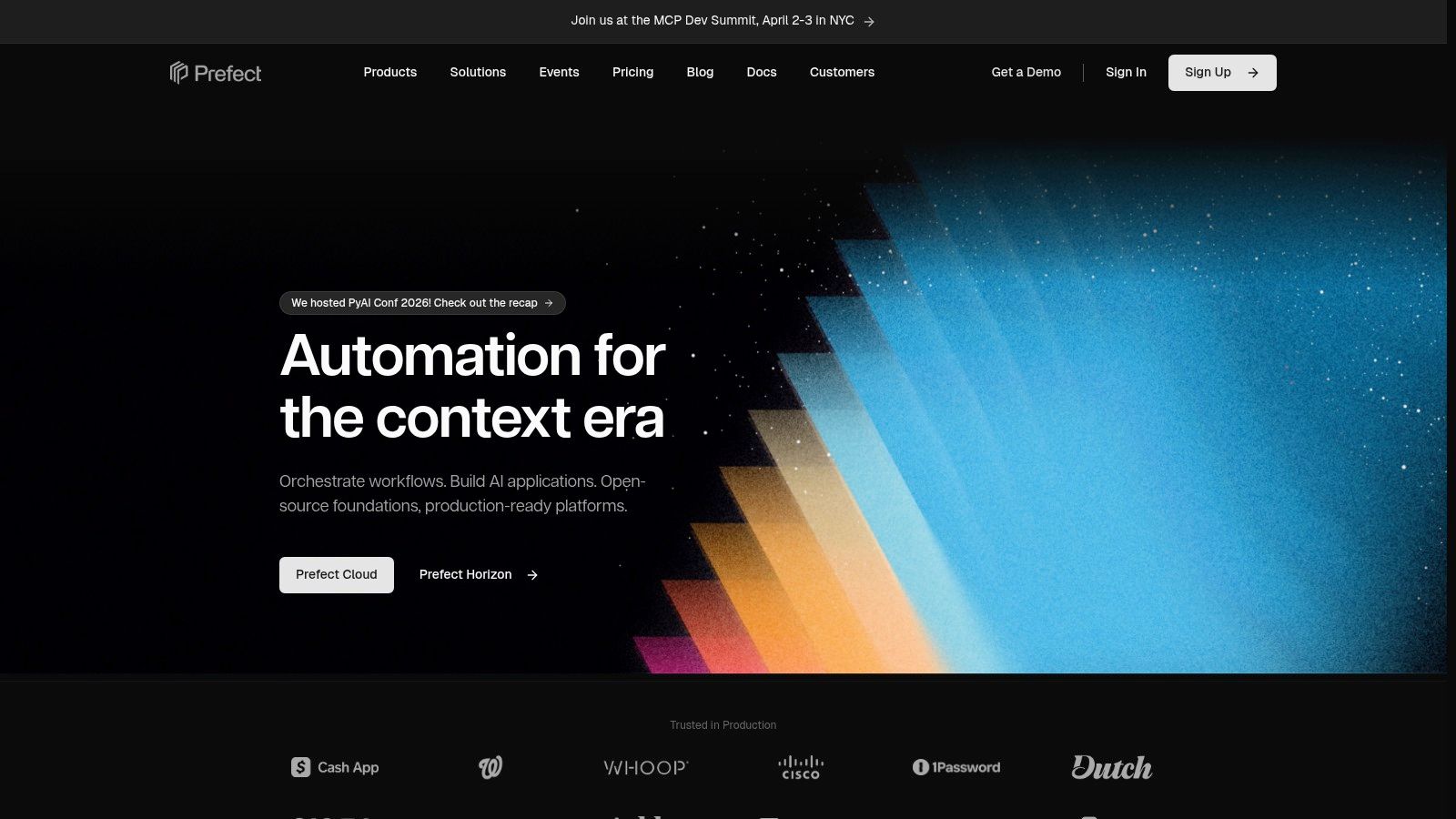
Prefect distinguishes itself as a strong Apache Airflow alternative by focusing heavily on developer experience and modern Python conventions. It treats workflows as code, allowing developers to define complex pipelines with simple Python functions and decorators (@flow and @task). The core design philosophy centers on a hybrid execution model: you run your code on your own infrastructure (BYO compute), while the Prefect Cloud or a self-hosted server handles orchestration, scheduling, and observability. This separation provides security and flexibility while offloading the burden of managing the control plane.
How We Tested & Our Honest Feedback
To test Prefect, we refactored a set of daily data validation and reporting jobs that were becoming brittle in Airflow. We also created a dynamic workflow that generated a variable number of tasks based on input data, a common pain point in Airflow. The learning curve was gentle for our Python-proficient team. Defining flows felt natural, and the ability to run and test a flow with a simple my_flow() function call locally was a major productivity boost. The UI is clean and provides immediate insight into runs, logs, and schedules. We particularly appreciated the "Blocks" feature for securely storing and reusing configurations like database credentials and cloud provider settings, which simplified our deployment configurations.
The main adjustment was getting accustomed to the agent and work pool concepts for connecting our compute environments to the control plane. Our honest feedback is that while powerful, this architectural pattern is different from Airflow's all-in-one scheduler/worker model and requires a bit of a learning curve to master for complex deployments.
Key Features:
- Python-Native API: Uses simple decorators to turn any Python function into a unit of work.
- Hybrid Execution Model: Maintains a clear separation between your code's environment and the orchestration engine.
- Dynamic Workflows: Natively supports dynamic, data-driven pipelines that can change their structure at runtime.
- Reusable "Blocks": A secure and version-controlled way to manage infrastructure and service configurations.
Pricing Considerations
Prefect offers a generous free Hobby tier on its cloud platform, which is great for individual developers and small projects. The Standard plan introduces team collaboration features, while the Enterprise plan adds SSO, RBAC, and dedicated support. For self-hosting, the open-source server is fully functional. The paid plans provide a managed and scalable control plane without requiring you to operate it.
- Website: https://www.prefect.io
3. Kestra
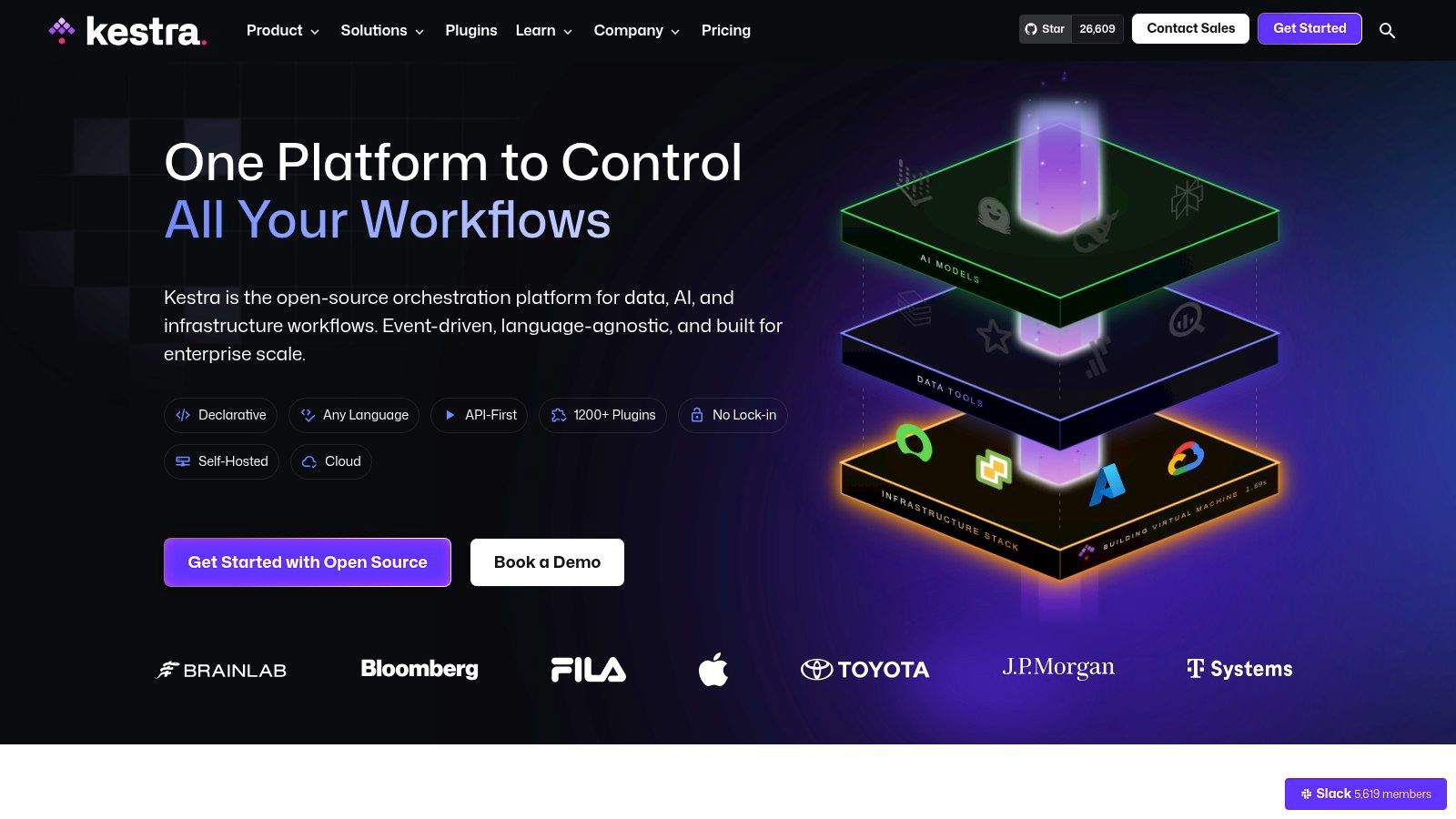
Kestra offers a fundamentally different approach compared to many Python-centric Apache Airflow alternatives. It is a language-agnostic, event-driven orchestrator where workflows are defined declaratively using YAML. This "pipeline-as-code" methodology, built on a robust Java backend, makes it accessible to a wider audience, including DevOps engineers and analysts who may not be Python experts. Kestra's architecture is designed for both high-availability batch processing and real-time, event-triggered workflows, positioning it as a tool for more than just data pipelines.
How We Tested & Our Honest Feedback
Our testing of Kestra involved a multitude of use cases to stress its declarative nature. We built a workflow that reacted to a file landing in an S3 bucket, triggered a dbt Cloud job, and then sent a Slack notification. We also tested its ability to orchestrate non-data tasks by creating a CI/CD-like pipeline that ran shell scripts inside Docker containers. The YAML-first approach was surprisingly fast to get started with. The web UI provided excellent real-time feedback, showing logs and the flow's progress without needing to refresh. This combination of YAML for definition and a powerful UI for monitoring was a key highlight.
Our honest feedback is that the move away from writing imperative Python code for orchestration logic was a significant adjustment. While Kestra can run Python scripts, the core philosophy is declarative, which might feel restrictive for teams accustomed to the programmatic control offered by other tools.
Key Features:
- Declarative YAML Workflows: Define entire pipelines, including triggers and tasks, in simple YAML files for clear, version-controlled orchestration.
- Event-Driven Architecture: Natively supports triggers from events like file uploads, message queues, or API calls, enabling real-time processing.
- Language Agnostic: Run scripts and applications written in any language (Python, R, shell, Node.js) via its command-line interface or Docker tasks.
- Rich Plugin Ecosystem: A growing library of plugins provides pre-built tasks for common services like Snowflake, BigQuery, Fivetran, and dbt.
Pricing Considerations
Kestra provides a powerful open-source version with no limitations on features like tasks or workflows, which can be self-hosted. For businesses seeking a managed solution, the Kestra Enterprise Edition (on-premise or cloud) adds features like advanced security (SSO, RBAC), high availability, and dedicated support. The cloud version operates with a managed control plane, simplifying operational overhead.
- Website: https://kestra.io
4. Argo Workflows
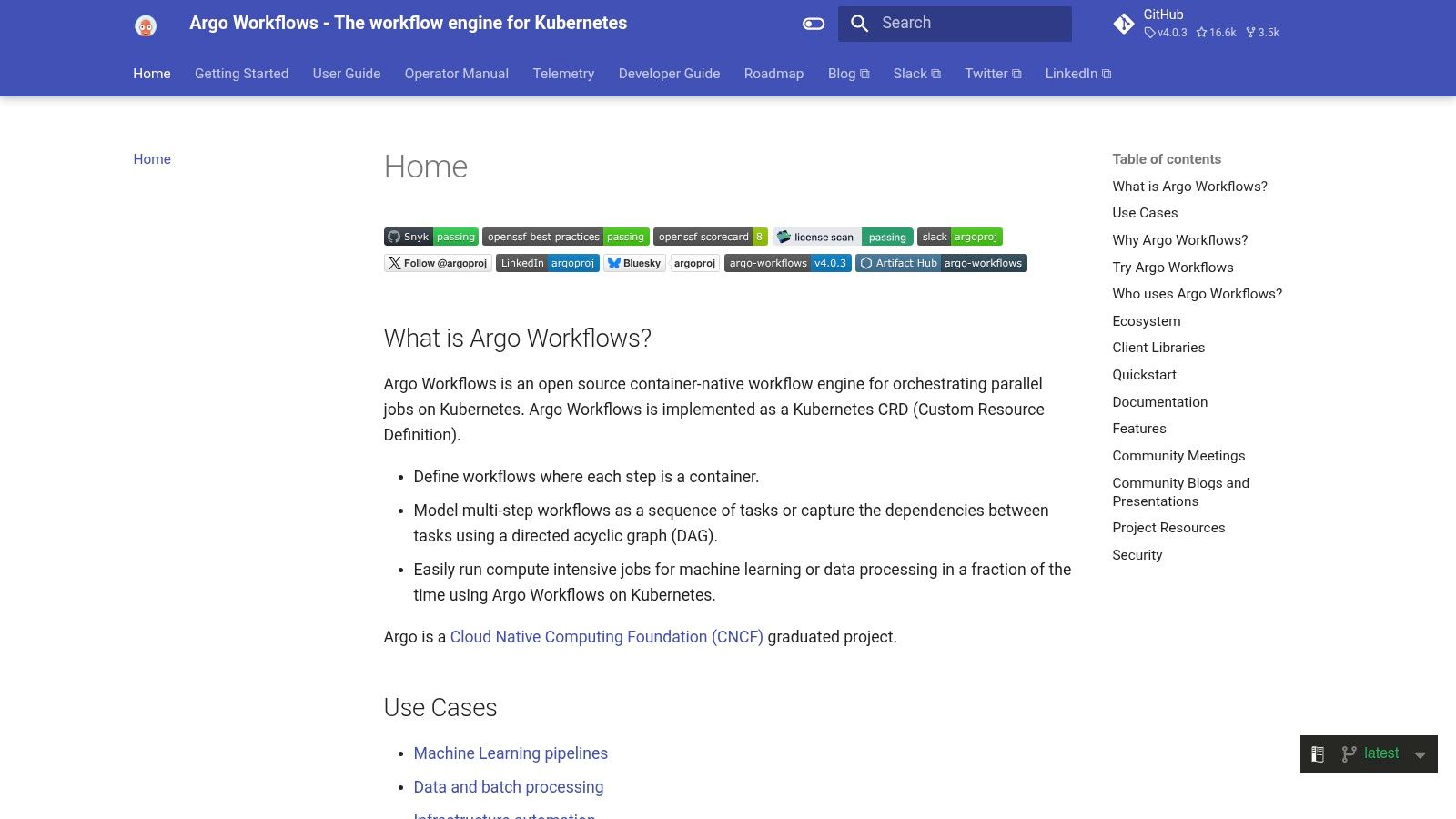
Argo Workflows positions itself as a Kubernetes-native workflow engine, making it a powerful Apache Airflow alternative for teams deeply invested in the container ecosystem. It treats every step in a workflow as a distinct container, defining pipelines as Kubernetes Custom Resource Definitions (CRDs). This container-first approach provides immense scalability and cloud-agnostic execution, as jobs run directly on your cluster's resources without a separate orchestration runtime. For organizations committed to Kubernetes for their compute, Argo offers a natural, low-overhead way to manage complex, parallel batch and data processing jobs.
How We Tested & Our Honest Feedback
We deployed Argo Workflows on an existing EKS cluster and conducted two primary tests. First, we orchestrated a machine learning model training pipeline. Second, we stress-tested its parallelism by running a dynamic "fan-out/fan-in" workflow with dozens of parallel hyperparameter tuning jobs. Defining the DAG directly in YAML as a Workflow CRD felt native to our Kubernetes-centric operations. The ability to specify resource requests (CPU/memory) for each containerized step gave us granular control over cost and performance. Argo scaled out seamlessly using the underlying cluster's capacity.
However, our honest feedback is that the learning curve is steep if your team isn't already proficient with Kubernetes. Writing raw YAML for complex workflows can become verbose and error-prone. We found relief using the Python SDK (Hera), which allowed us to define pipelines programmatically, but this adds another layer to learn.
Key Features:
- Kubernetes-Native Architecture: Defines workflows as CRDs, with each task running as a pod.
- Container-First Execution: Every step is a container, enabling language-agnostic task creation.
- Advanced Parallelism: Excellent support for dynamic fan-out/fan-in patterns and complex DAGs.
- GitOps Integration: Works well with tools like Argo CD for managing workflow deployments from a Git repository.
Pricing Considerations
Argo Workflows is a CNCF-graduated open-source project and is completely free. The costs are indirect and are tied to the compute, storage, and networking resources consumed by your Kubernetes cluster (e.g., EKS, GKE, AKS, or on-premises). There is no commercial vendor or managed service, which means your team is responsible for all setup, maintenance, and scaling.
5. Flyte
Flyte is an open-source, Kubernetes-native workflow automation platform that excels in orchestrating complex, large-scale data and machine learning pipelines. Originally developed at Lyft and now stewarded by Union.ai, it is built with MLOps in mind. Flyte’s core design prioritizes reproducibility, reliability, and resource efficiency by defining workflows as strongly-typed Python functions that are versioned and cached automatically. This structure makes it a powerful Apache Airflow alternative for teams requiring production-grade ML infrastructure.

How We Tested & Our Honest Feedback
We put Flyte to the test by containerizing a multi-task ML training pipeline that involved feature engineering, model training, and evaluation. We specifically tested its caching by re-running the pipeline with minor code changes to see if it intelligently skipped unchanged tasks. The Python-first authoring was very natural for our data science team. The platform’s Kubernetes-native architecture allowed us to specify precise resource requests (CPU, memory, GPU) for each task, a huge win for cost management. The automatic caching (memoization) was impressive, saving significant compute time during iterative development.
Our honest feedback is that the setup is not for the faint of heart. While Flyte abstracts away much of the Kubernetes complexity, a foundational understanding of containers and K8s is necessary for a smooth open-source deployment. It's significantly more involved than a simple pip install. For those looking to bypass this, the managed service from Union.ai is the recommended path.
Key Features:
- Kubernetes-Native: Designed from the ground up to run on Kubernetes, enabling scalable and resource-aware task execution.
- Strong Typing & Reproducibility: Enforces type safety between tasks and automatically versions all code and data dependencies for auditable runs.
- Memoization (Caching): Intelligently caches task outputs, reusing results from previous runs with identical inputs and code versions.
- Python-First SDK: Allows data scientists and engineers to define complex workflows in pure Python, with a web UI for visualization and management.
Pricing Considerations
Flyte is a completely open-source project under the Apache 2.0 license and is free to deploy on your own Kubernetes cluster. Union.ai provides a commercial managed offering, Union Cloud, which handles the infrastructure and adds enterprise features. Pricing for Union Cloud is based on a combination of platform fees and compute consumption, with specific tiers for different organizational needs.
- Website: https://flyte.org
6. Apache NiFi
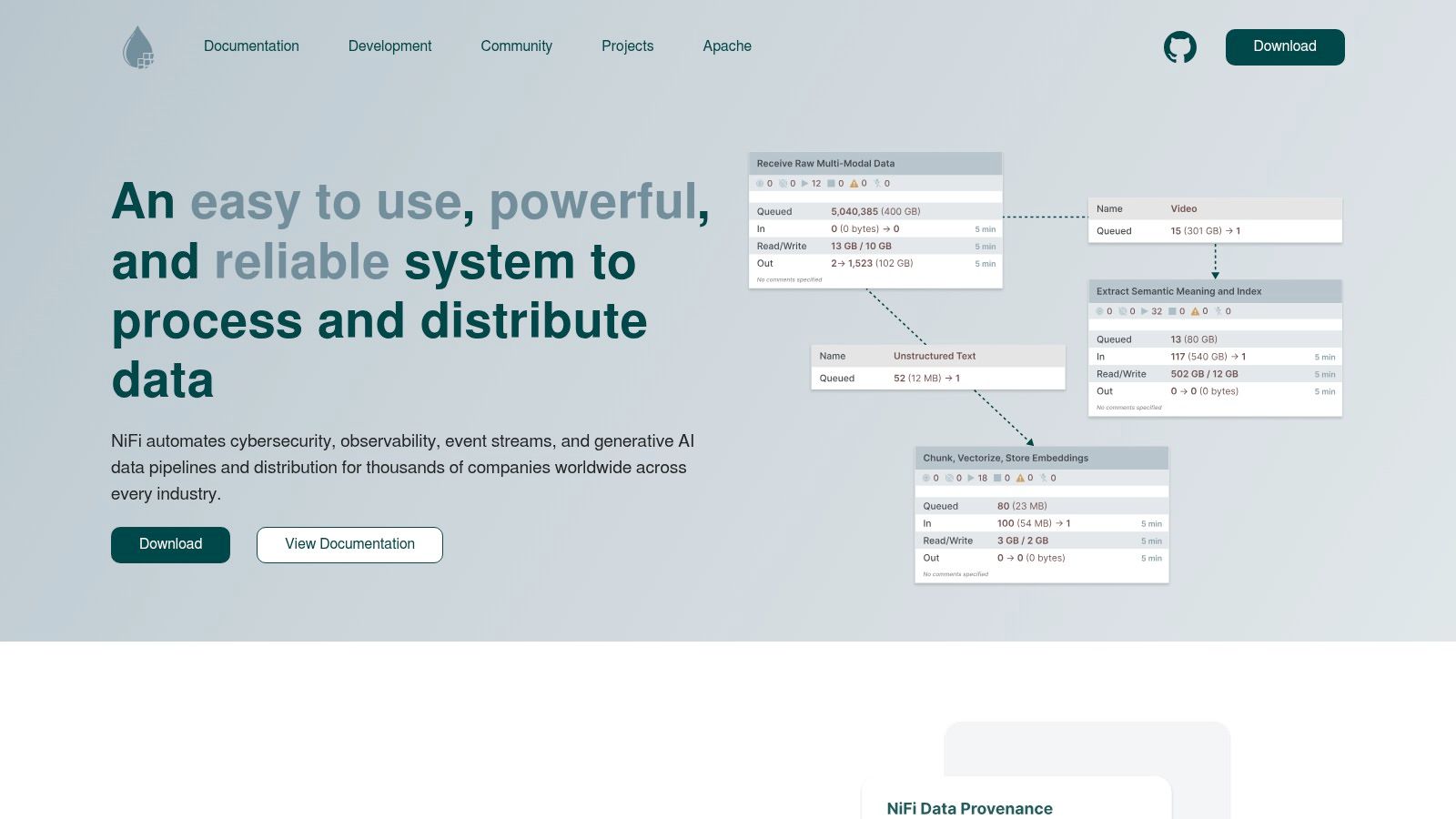
Apache NiFi stands apart from other Apache Airflow alternatives by focusing entirely on real-time data ingestion and flow, rather than batch job scheduling. It provides a visual, drag-and-drop interface for building complex data routing and transformation pipelines. NiFi excels at moving data from disparate sources to centralized locations, managing data pressure, and providing granular, real-time data provenance for every piece of data that flows through the system.
How We Tested & Our Honest Feedback
We tested NiFi with two distinct, high-volume scenarios. First, we built a multi-source ingestion flow to collect logs from various microservices and route them into Kafka and a long-term object store. Second, we simulated a "bursty" data source flooding the system to test NiFi's back-pressure and buffering capabilities. The visual, flow-based programming was incredibly fast for prototyping. The back-pressure and prioritization features were powerful; we watched NiFi automatically buffer data without dropping it, ensuring data integrity.
Our honest feedback: NiFi is not a direct replacement for Airflow's core scheduling function. It's an event-driven data movement tool, not a workflow orchestrator for dependent batch jobs. Attempting to use it for complex, multi-step transformations in a data warehouse proved cumbersome and not the right fit for the tool.
Key Features:
- GUI-Driven Design: Visually construct data flows using a catalog of over 300 pre-built processors.
- Data Provenance: Automatically records a detailed, indexed history of all data that flows through the system.
- Back-Pressure & Buffering: Inherently manages data queues between processors to handle data bursts and prevent system overloads.
- Site-to-Site Protocol: A highly efficient and secure protocol for transferring data between NiFi clusters.
Pricing Considerations
Apache NiFi is a completely free, open-source project under the Apache Software Foundation. There are no licensing fees, and you can run it on your own hardware. Commercial support and enterprise-grade distributions are available from third-party vendors like Cloudera, which bundle NiFi as part of their data platforms.
- Website: https://nifi.apache.org
7. Azure Data Factory
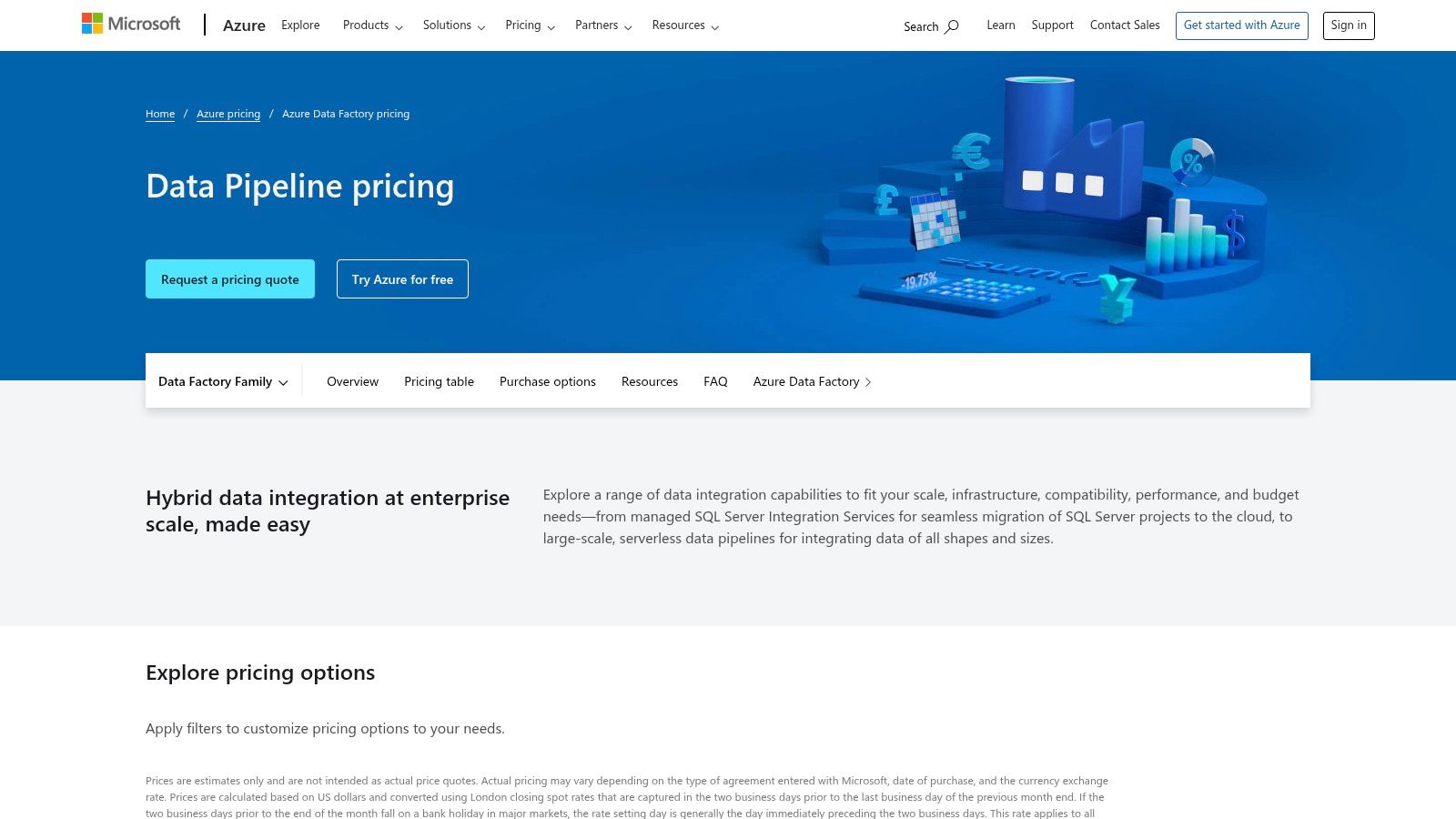
For organizations deeply embedded in the Microsoft Azure ecosystem, Azure Data Factory (ADF) serves as a potent, managed alternative to Apache Airflow. It is a cloud-native data integration service built for complex ETL and ELT projects. ADF provides a low-code, drag-and-drop user interface for building pipelines, which appeals to a broader range of developers and data analysts, while still offering code-based flexibility for advanced scenarios. This dual approach makes it a strong contender for teams looking to accelerate development without sacrificing power.
How We Tested & Our Honest Feedback
Our team conducted multiple tests with ADF. We handled a daily data ingestion task from an on-premise SQL server to Azure Blob Storage, followed by transformation using a Synapse notebook. We also tested its "lift-and-shift" capability by migrating an existing SSIS package. The graphical interface significantly sped up initial pipeline creation. The 100+ pre-built connectors were a major benefit, allowing us to connect to sources and destinations with minimal configuration. Triggering the pipeline was straightforward, and the built-in monitoring provided clear insights.
Our honest feedback is that the pricing model is highly granular and requires careful monitoring to avoid unexpected costs. It also became clear that while ADF can connect to outside services, its performance and ease-of-use are optimized for Azure-to-Azure workflows. It’s less a general-purpose orchestrator and more the connective tissue for the Azure data stack.
Key Features:
- Visual-First Pipelines: A GUI with drag-and-drop activities and over 100 connectors for building data workflows.
- SSIS Lift-and-Shift: Provides a managed environment to run existing SQL Server Integration Services (SSIS) packages in the cloud.
- Serverless Data Flows: Build and execute code-free data transformations at scale using mapping data flows.
- Deep Azure Integration: Native connectivity with Azure Synapse, Databricks, Azure Functions, and the broader Fabric ecosystem.
Pricing Considerations
Azure Data Factory employs a pay-as-you-go pricing model that can be complex. Costs are accrued based on pipeline orchestration runs, data flow execution cluster hours, the number of data movement activities, and the amount of data moved. This provides granularity but requires careful monitoring to manage expenses effectively. There are no upfront costs or termination fees.
8. AWS Step Functions
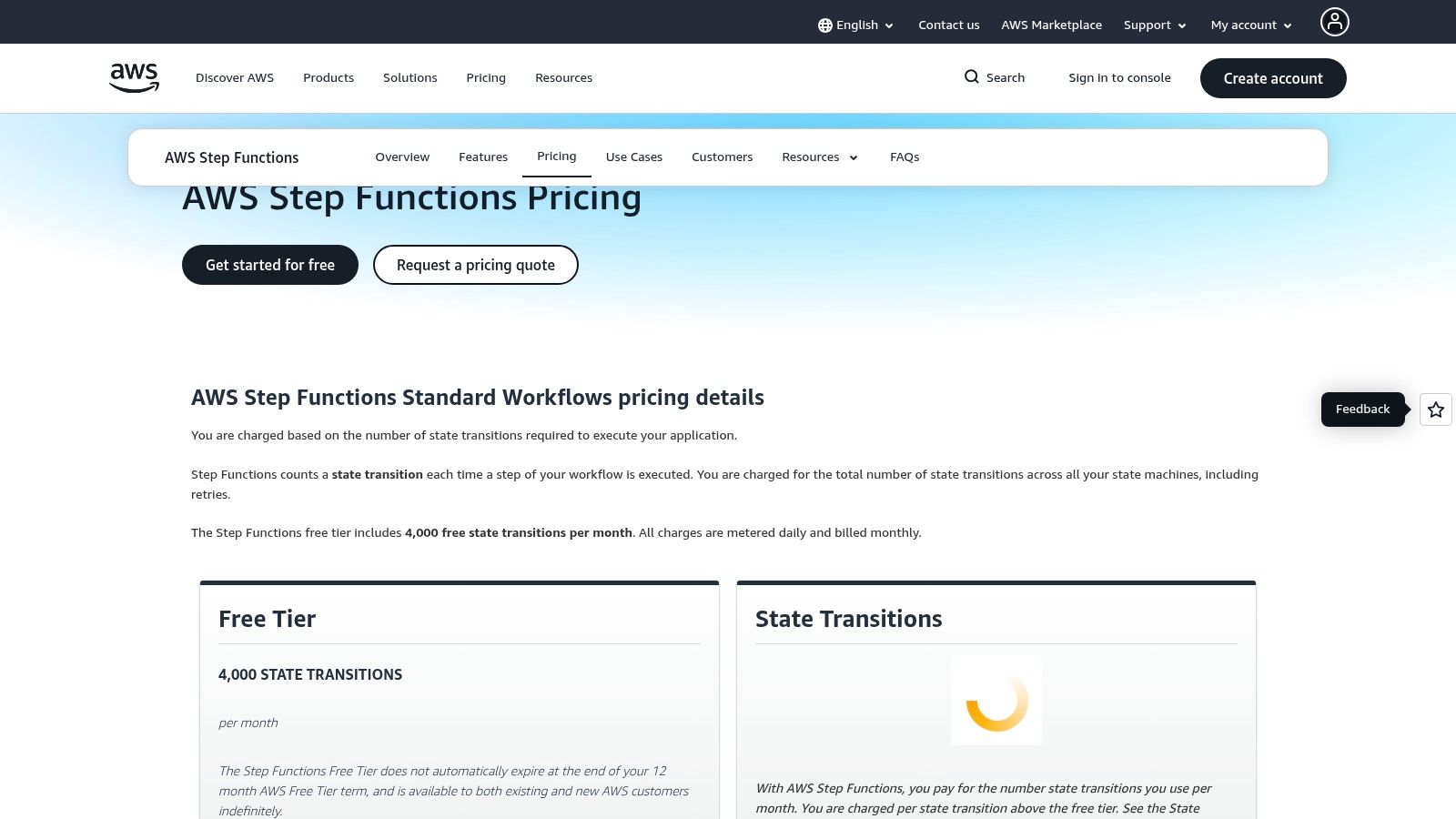
AWS Step Functions provides a serverless, state-machine-based approach to workflow orchestration, making it a powerful Apache Airflow alternative for teams deeply embedded in the Amazon Web Services ecosystem. Instead of defining pipelines in Python code, you build visual state machines that coordinate AWS services like Lambda, Glue, and SageMaker. This model excels at event-driven architectures and complex, branching logic, where tasks are triggered by S3 events or API Gateway calls, rather than running on a fixed schedule.
How We Tested & Our Honest Feedback
We put AWS Step Functions to the test by re-architecting a real-time data processing job that was poorly suited for Airflow’s batch orientation. The workflow was triggered by file uploads to S3, running a series of Lambda functions for validation and transformation. We also created a workflow with complex error handling and branching logic to test its state machine capabilities. The visual editor was surprisingly effective for designing and debugging the flow of states. We could visually track executions in real-time and pinpoint where errors occurred.
Our honest feedback is that the learning curve associated with its state language (Amazon States Language) and the vendor lock-in are significant drawbacks. Migrating this workflow off of AWS would require a complete rebuild. However, for AWS-native applications, the tight integration and elimination of server management were significant wins.
Key Features:
- Visual Workflows: Design and monitor state machines in a graphical console, which simplifies complex logic.
- Direct AWS Service Integrations: Natively calls over 200 AWS services, making it a central hub for cloud automation.
- Standard vs. Express Workflows: Choose between long-running, auditable workflows (up to a year) or high-throughput, short-duration ones (up to 5 minutes).
- Built-in Error Handling: Configure retries and fallback states directly within the state machine definition for resilient applications.
Pricing Considerations
Step Functions has a pay-per-use model that differs by workflow type. Standard Workflows are billed per state transition, while Express Workflows are billed based on the number of requests and duration. While the free tier is generous (4,000 state transitions per month), costs can become hard to predict for high-volume or complex workflows. It removes infrastructure overhead, but you trade that for consumption-based billing that requires careful monitoring.
9. Google Cloud Workflows
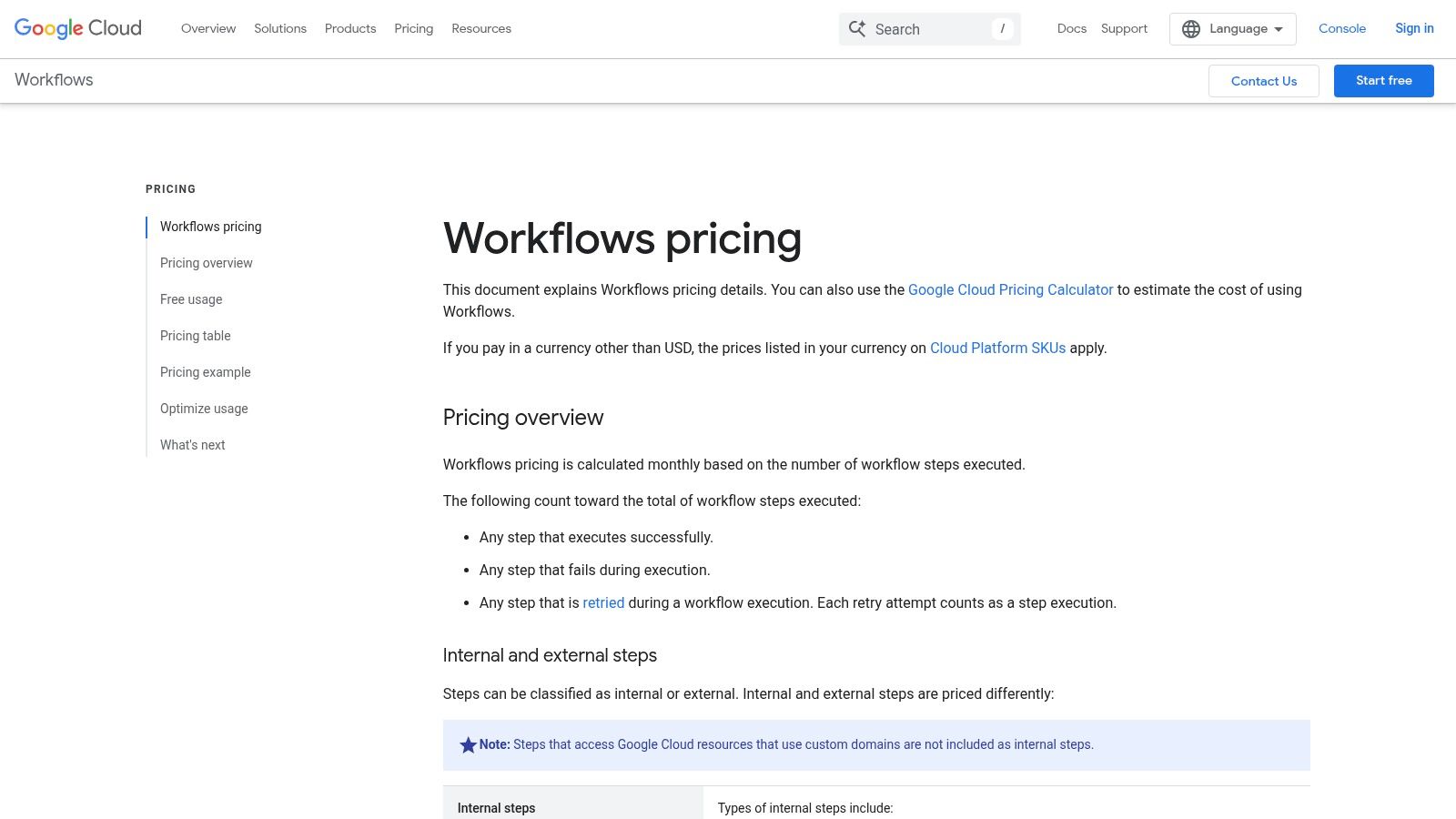
For teams deeply embedded in the Google Cloud ecosystem, Google Cloud Workflows offers a powerful, serverless alternative to Apache Airflow for service orchestration. Instead of Python DAGs, workflows are defined in YAML or JSON, focusing on connecting and sequencing API calls across GCP services like Cloud Functions, Cloud Run, and BigQuery. It excels at being the "glue" for infrastructure automation and event-driven application logic, rather than a dedicated data engineering platform.
How We Tested & Our Honest Feedback
We tested Google Cloud Workflows by orchestrating a sequence of API-driven tasks: triggering a Cloud Function to fetch data, calling a BigQuery job to process it, and then notifying a downstream service via a Cloud Run endpoint. We also built a separate workflow to test its sub-workflow and iteration features. Defining this logic in YAML was straightforward and declarative. The serverless nature meant we had zero infrastructure to manage, a significant operational win for simple, event-based jobs.
Our honest feedback is that this is not a data-aware orchestrator. There's no built-in data lineage, asset catalog, or a user-friendly UI for visualizing data dependencies like you'd find in Dagster. It’s a pure state machine for service calls, making it less suitable for complex, multi-stage data transformations where observability is key. For a team needing a simple, GCP-native scheduler, it is a strong contender.
Key Features:
- Declarative Orchestration: Define complex workflows with branching, loops, and retries using simple YAML or JSON syntax.
- Serverless Execution: Fully managed service with no servers to provision or scale, offering a true pay-per-use model.
- Native GCP Integration: First-class connectors for calling Cloud Functions, Cloud Run, BigQuery APIs, and other Google Cloud services.
- Built-in Error Handling: Robust mechanisms for retries with exponential backoff and custom error handling steps.
Pricing Considerations
Google Cloud Workflows follows a consumption-based pricing model with a generous free tier. You are billed based on the number of internal and external steps executed within your workflows. The first 5,000 internal steps per month are free, making it cost-effective for low-to-medium frequency orchestration tasks entirely within the GCP environment.
- Website: https://cloud.google.com/workflows
10. Temporal
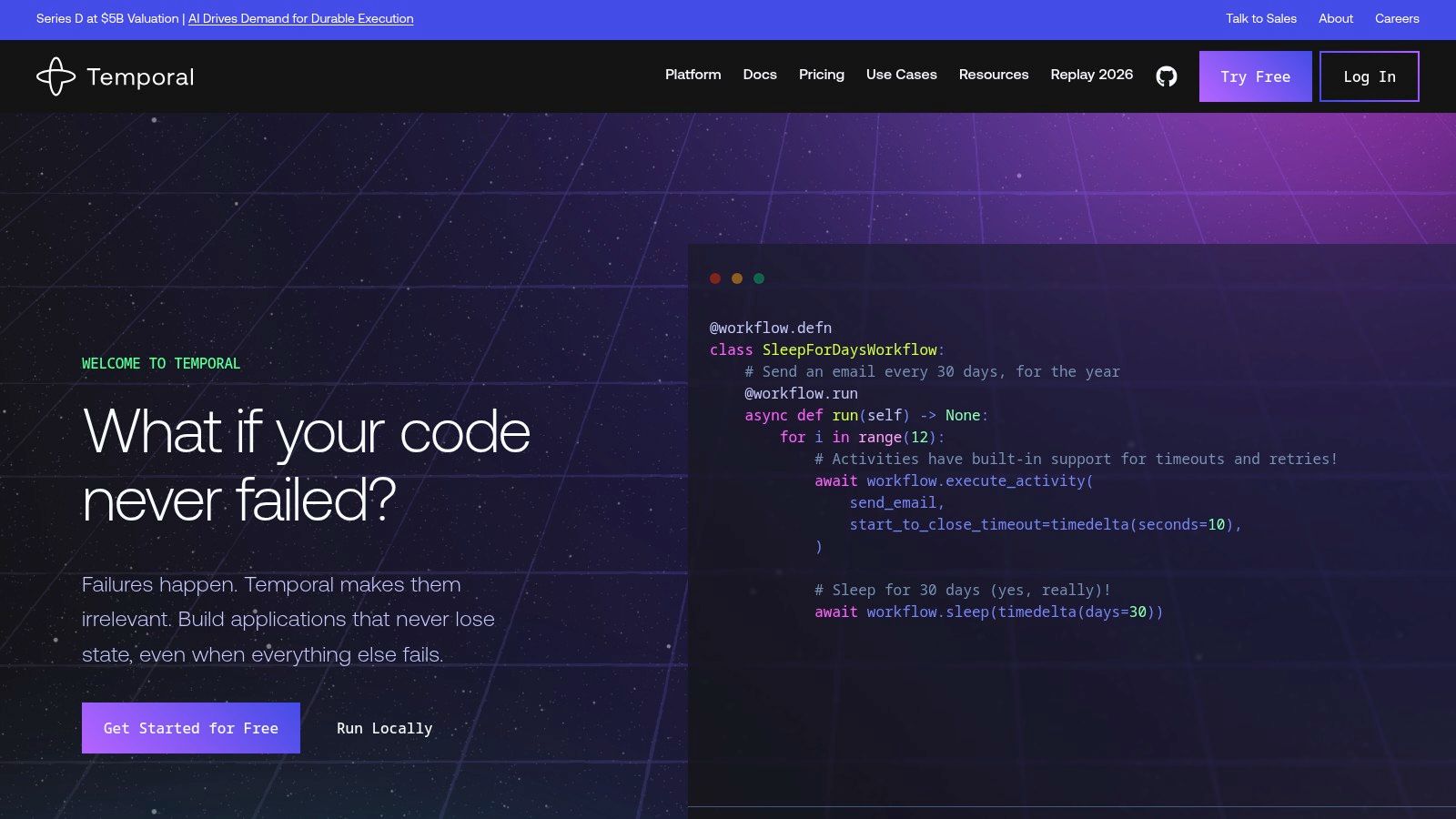
Temporal offers a fundamentally different approach compared to traditional orchestrators like Airflow. It is not a data pipeline-specific tool but a general-purpose, durable execution system for writing reliable, long-running applications. Instead of defining DAGs, you write your business logic as code using Temporal's SDKs (available in Go, Java, TypeScript, and Python). The platform then ensures this code executes durably, handling state management, retries, and failures automatically. This makes it a powerful Apache Airflow alternative for mission-critical processes that extend beyond simple data transformation, such as financial transactions or complex, human-in-the-loop workflows.
How We Tested & Our Honest Feedback
We put Temporal to the test by re-implementing a multi-day order fulfillment process that involved several API calls, potential manual approvals, and complex compensation logic (e.g., refunding a user if a specific step failed). In Airflow, this was a brittle chain of sensors. With Temporal's Python SDK, we expressed the entire flow in a single function. We then simulated server restarts and network failures during execution to verify its durability claims. The ability to sleep a workflow for days or wait for an external signal without consuming active compute was a revelation.
Our honest feedback is that Temporal is not a simple orchestrator; it's a new programming model. The team needed significant time to understand concepts like Workflows, Activities, and Workers. It is significantly more powerful for stateful application logic but requires more engineering buy-in than a DAG-based tool.
Key Features:
- Durable Execution: Workflows maintain their state and continue execution even if the underlying servers restart or fail.
- Code-First SDKs: Define complex, stateful logic in familiar programming languages, not YAML or a restrictive DSL.
- Strong Consistency Guarantees: Provides tools for building applications with exactly-once execution semantics, crucial for transactional systems.
- Flexible Deployment: Can be self-hosted using the robust open-source version or consumed via the managed Temporal Cloud.
Pricing Considerations
The open-source version of Temporal is free and powerful, requiring you to manage the infrastructure. Temporal Cloud, the managed service, uses a consumption-based model that bills based on the number of "actions" (e.g., workflow starts, activity completions) and storage, with a generous free tier for getting started. Enterprise features are available in higher-tier plans.
- Website: https://temporal.io
11. Kubeflow Pipelines
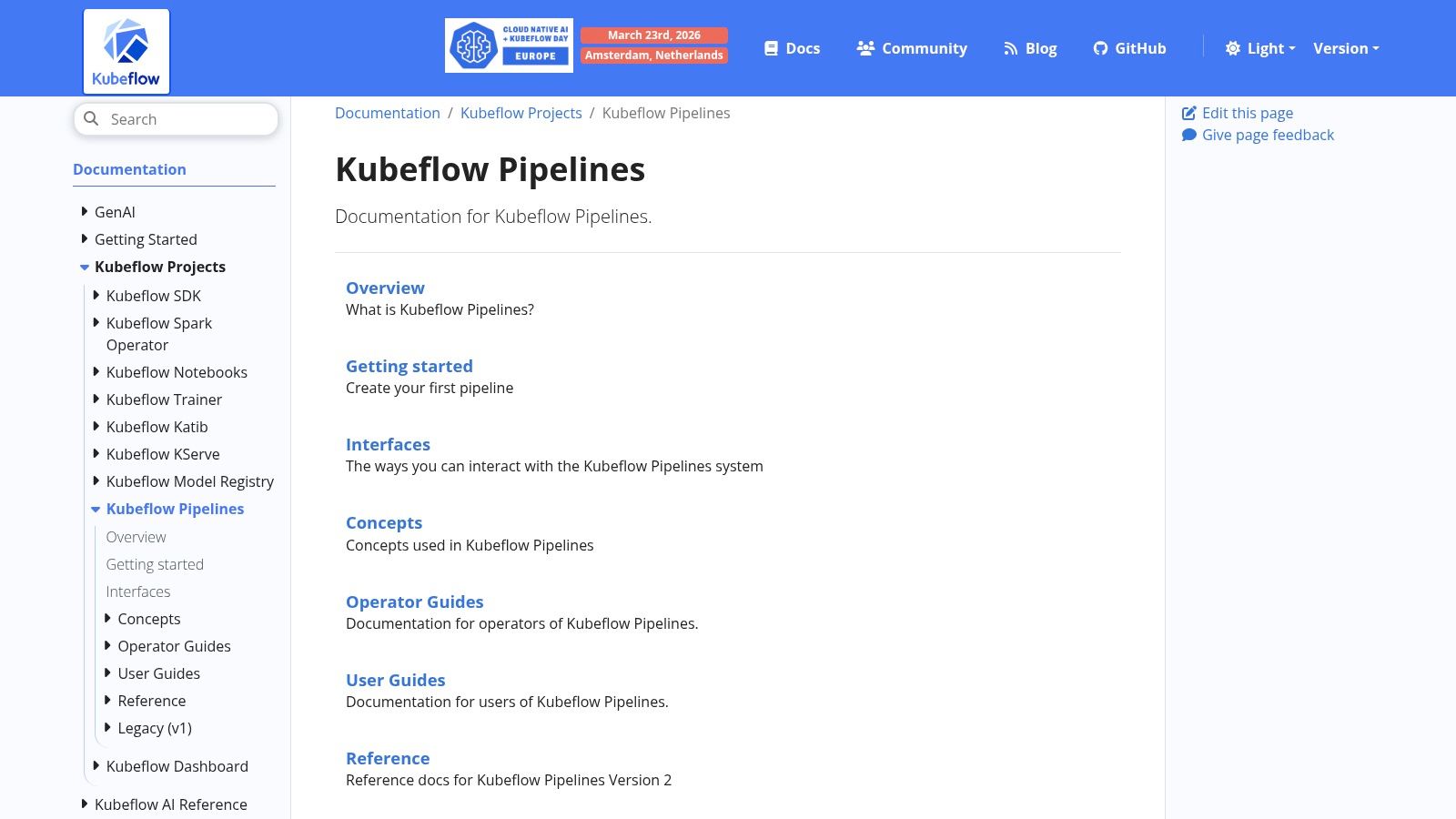
Kubeflow Pipelines offers a specialized alternative to Apache Airflow, designed specifically for orchestrating machine learning (ML) workflows on Kubernetes. While Airflow is a general-purpose orchestrator, Kubeflow focuses intensely on the ML lifecycle, including model training, hyperparameter tuning, evaluation, and deployment. Its core strength lies in its container-native approach, treating each step in an ML pipeline as a self-contained component that can be easily reused, shared, and versioned. This makes it an excellent choice for teams looking to build reproducible and scalable ML systems.
How We Tested & Our Honest Feedback
Our team tested Kubeflow Pipelines by re-implementing a computer vision model training workflow that involved data preprocessing, distributed training on GPUs, and model validation. We specifically focused on its experiment tracking features, creating multiple pipeline runs with different hyperparameters and comparing the resulting model accuracy and artifacts directly in the UI. Defining pipelines using the Python SDK felt intuitive for our data scientists. The UI provided excellent visibility into artifacts and metrics for each run, a feature that is not native to Airflow.
Our honest feedback is that the operational overhead is significant. Kubeflow runs on Kubernetes, and managing the underlying cluster requires a dedicated skillset. It is not a tool for general data engineering tasks like ETL; its focus is squarely on ML, and using it for simple data movement felt like overkill.
Key Features:
- ML-Centric Orchestration: Built-in support for experiment tracking, artifact management, and metrics visualization.
- Reusable Components: Pipelines are composed of containerized components that can be shared across teams and projects.
- Kubernetes Native: Inherits the portability and scalability of Kubernetes, allowing pipelines to run on any cloud or on-premise environment.
- Python SDK: Enables data scientists to define complex pipelines programmatically in a familiar language.
Pricing Considerations
Kubeflow is a fully open-source project and is free to use. The costs are associated with the underlying infrastructure (e.g., your Kubernetes cluster compute, storage, and networking) on which it runs. Various vendors offer managed Kubeflow distributions which can simplify deployment but come with their own pricing models.
12. Luigi
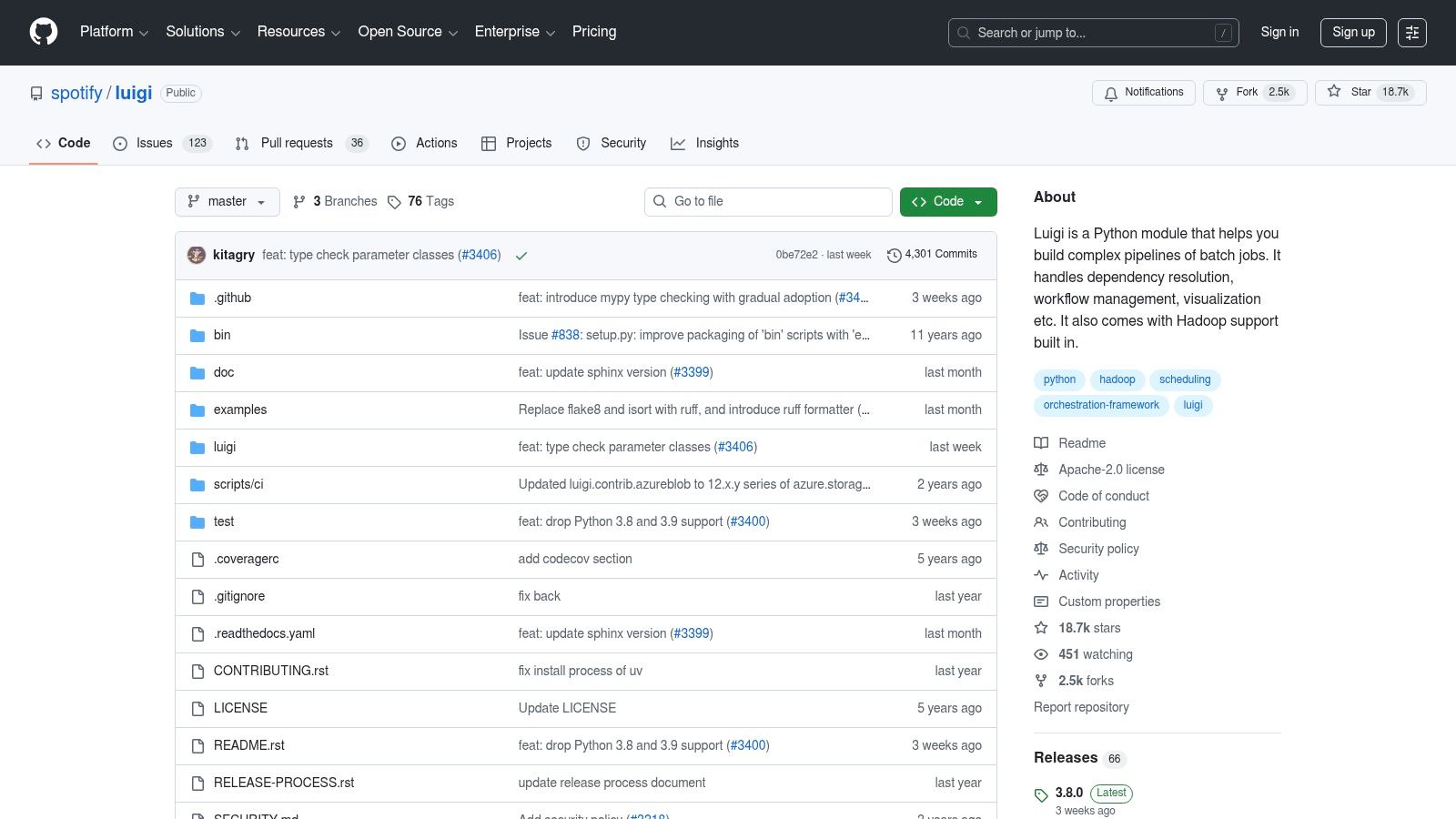
Luigi, an open-source Python package from Spotify, represents a classic, code-first approach to building batch data pipelines. It functions more as a library than a full-fledged platform, focusing on a simple but effective model of tasks and their target outputs. Where Airflow manages workflows via a central scheduler and complex DAG configurations, Luigi defines dependencies programmatically, making pipelines self-contained within your Python codebase. This simplicity makes it a durable Apache Airflow alternative for straightforward, single-team ETL jobs where minimal operational overhead is the priority.
How We Tested & Our Honest Feedback
We tested Luigi by building a simple data processing pipeline that downloads a file, processes it, and loads it into a local database. We also set up a multi-task workflow with interdependencies to evaluate its dependency resolution mechanism. Running tasks from the command line was direct and easy, and debugging felt like standard Python development. The core concepts of Task and Target (the output a task produces) were intuitive for our Python developers. The atomicity of tasks was a key benefit; re-running the entire pipeline correctly skipped completed steps.
Our honest feedback is that the lack of a modern user interface and rich observability features was immediately apparent. While Luigi offers a basic visualizer, it doesn't compare to the detailed monitoring provided by newer tools. We found it best suited for projects where the pipeline logic is stable and the team prefers managing everything directly in code without the abstraction of a heavy UI.
Key Features:
- Code-Centric Dependencies: Pipeline dependencies are defined explicitly in Python code, making workflows easy to version-control.
- Atomic Tasks: The
Targetconcept ensures tasks are atomic and idempotent; if a target file exists, the task won't re-run. - Minimal Overhead: As a library, it has a very small footprint and can be easily embedded into existing projects.
- Hadoop Support: Includes helpers for working with HDFS and running MapReduce jobs, reflecting its origins.
Pricing Considerations
Luigi is completely free and open-source under the Apache 2.0 License. There are no commercial versions, paid tiers, or managed services. All costs are related to the infrastructure you use to run your Python scripts and the optional central scheduler daemon. This makes it an extremely cost-effective choice for teams capable of managing their own infrastructure.
- Website: https://github.com/spotify/luigi
Airflow Alternatives: 12-Tool Feature Comparison
| Product | Core strength / Use case | Developer experience / UX | Integrations & ecosystem | Best for / Target audience | Pricing & deployment |
|---|---|---|---|---|---|
| Dagster | Asset-based data orchestration; lineage & freshness checks | Strong developer ergonomics; clean UI; local-first workflows | dbt, Snowflake, BigQuery, Spark; Dagster+ hosted option | Data engineering, ELT/ML/analytics teams | OSS + Dagster+ hosted; advanced features on paid tiers |
| Prefect | Python-first workflow orchestration with hybrid control plane | Gentle learning curve for Python; Flows/Tasks API; good observability | BYO compute (K8s/ECS/VM), serverless runtimes; reusable Blocks | Python-centric teams and small–medium data teams | Free Hobby tier; Prefect Cloud managed control plane; paid enterprise plans |
| Kestra | Declarative, event-driven orchestration (YAML-first) | Fast time-to-first-run; low ops but YAML-first learning curve | Plugin ecosystem; cloud managed control plane available | Mixed data, DevOps, and automation workloads | OSS + managed cloud option; newer ecosystem |
| Argo Workflows | Kubernetes-native, container-first parallel workflows | Powerful but requires Kubernetes expertise; YAML-heavy without SDK | GitOps integrations; multi-cloud k8s portability | Kubernetes-centric teams running large-scale batch/ML | OSS running on K8s; minimal extra runtime; self-hosted |
| Flyte | ML/data orchestration with caching, versioning, infra-aware scheduling | Python-first authoring; production MLOps features; steeper setup | Spark, Ray, W&B, Snowflake, BigQuery integrations | MLOps teams needing reproducibility on K8s | OSS + enterprise/managed options; best on Kubernetes |
| Apache NiFi | GUI-driven dataflow for real-time and batch ingestion | Visual UI; very fast prototyping; strong operational controls | Large processor/connector catalog; site-to-site cluster transfer | Ingestion, streaming, operational data movement teams | OSS; self-hosted clusters; not a DAG scheduler |
| Azure Data Factory | Managed data integration with low-code pipelines | GUI + code flexibility; enterprise security & monitoring | 100+ connectors; Fabric/Synapse/SSIS migration paths | Azure-centric enterprises and ETL teams | Pay-as-you-go; complex activity-based pricing |
| AWS Step Functions | Serverless state machines for AWS service orchestration | Visual editor; fully managed; scales without clusters | Deep AWS integrations (Lambda, Glue, SageMaker, etc.) | AWS-native event-driven application & data workflows | Managed AWS service; pricing by transitions/duration (can be opaque) |
| Google Cloud Workflows | Serverless orchestration for GCP APIs & HTTP services | YAML/JSON definitions; simple for GCP users; serverless UX | Cloud Run, Functions, BigQuery and other GCP services | GCP-centric teams gluing cloud services | Pay-per-use serverless billing; managed service |
| Temporal | Durable, code-first workflow engine for long-running stateful processes | Code-first SDKs (Go/Java/TS/Python); strong reliability; steeper ramp | Multi-language SDKs; integrates into infra and services | Mission-critical long-running business processes | OSS or Temporal Cloud managed offering; adoption of programming model needed |
| Kubeflow Pipelines | ML pipeline orchestration with experiment & artifact tracking | Python component authoring; UI for experiments; often uses Argo | Kubernetes portability; ML tooling integrations | ML lifecycle teams focused on training/experiments | OSS; runs on Kubernetes; managed distributions available |
| Luigi | Lightweight Python framework for batch ETL with explicit deps | Minimal overhead; easy to learn; code-centric | Hadoop/Spark contrib; simple scheduler & visualizer | Single-team, straightforward ETL and batch pipelines | OSS; simple self-hosted deployment; fewer modern features |
Making Your Final Decision: A Quick Checklist
Choosing the right orchestrator is a significant decision that will shape your data engineering and MLOps practices for years to come. Our hands-on testing of twelve prominent Apache Airflow alternatives has demonstrated one clear truth: the "best" tool does not exist in a vacuum. The ideal choice is deeply intertwined with your team's specific skills, your existing infrastructure, and the primary problems you need to solve. This final checklist is designed to help you distill the detailed information from our analysis and map it directly to your unique organizational context.
Prioritize Your Core Requirements
Before you get lost in feature-by-feature comparisons, anchor your decision-making process in these fundamental questions. Your answers will quickly narrow the field from twelve contenders to two or three strong candidates.
What is your primary use case? The function of the tool is the most important filter.
- General ETL/ELT: If your focus is on traditional data movement and transformation, the python-native approaches of Dagster and Prefect offer a great blend of power and developer experience. For teams preferring a declarative, language-agnostic model, Kestra is an excellent choice.
- Machine Learning Operations (MLOps): For pipelines that train and deploy models, you need tools built for the task. Flyte and Kubeflow Pipelines are top-tier, Kubernetes-native options that provide strong typing, caching, and versioning. Argo Workflows is a more general-purpose but highly effective alternative for ML if your team is already deep into the Argo ecosystem.
- Cloud Service Integration: If your goal is to simply "glue" together various services within a single cloud provider, sticking with the native tools is often the most direct path. AWS Step Functions, Azure Data Factory (ADF), and Google Cloud Workflows are designed for deep integration with their respective parent ecosystems.
- Event-Driven & Streaming Ingestion: For workflows that must react to real-time events or handle continuous data streams, look towards Apache NiFi with its visual flow-based paradigm or Kestra, which has a strong event-driven architecture at its core.
What is your team's dominant skill set? Aligning the tool with your team's existing knowledge reduces friction and speeds up adoption.
- Python-Centric Data Teams: Prefect, Dagster, and Flyte will feel most natural, allowing developers to define complex pipelines using familiar Python code and decorators.
- YAML / Declarative Proponents: If your team prefers configuration-as-code using a declarative format, Kestra, Argo Workflows, and Google Cloud Workflows are built around this principle.
- Kubernetes Experts: Teams with deep Kubernetes expertise will be most comfortable with Argo Workflows, Flyte, and Kubeflow Pipelines, which are all built on and for Kubernetes.
- Low-Code / Visual Builders: To empower analysts or teams less comfortable with code, the visual interfaces of Azure Data Factory and Apache NiFi provide a more accessible entry point.
Final Considerations for Implementation
Once you've shortlisted your options, consider these practical realities.
- Local Development Experience: If rapid, iterative local development and testing are critical for your team's productivity, you must prioritize tools that excel here. Our tests showed that Dagster and Prefect offer a superior, best-in-class local development loop, making it easier to catch errors before they hit production.
- Infrastructure and Operational Burden: Where will this tool run, and who will maintain it?
- Cloud-Agnostic / On-Premise: If you need to run on your own Kubernetes clusters or avoid vendor lock-in, open-source tools like Argo, Flyte, Dagster, and Prefect give you that control.
- Fully Managed: If you want to offload operational overhead, the managed cloud offerings like Dagster+, Prefect Cloud, or the native cloud services (ADF, Step Functions) are your best bet.
The definitive way to make a final choice is to move beyond reading and into doing. Select your top two candidates based on this checklist and run a proof-of-concept with a real-world pipeline from your organization. This practical test, informed by the in-depth analysis provided here, will give you the undeniable evidence needed to confidently select the right orchestration tool. For more unbiased, test-driven software guides, be sure to visit the Digital Software Reviews homepage.
Making a major software decision like choosing from these Apache Airflow alternatives requires trusted, hands-on research. At Digital Software Reviews, we specialize in providing exactly that, cutting through marketing fluff to deliver the practical insights you need. Let our comprehensive reviews and comparisons guide your next technology investment.