

Selecting the right warehouse management system is a critical decision that directly impacts operational efficiency, inventory accuracy, and customer satisfaction. The wrong choice can lead to costly implementation failures, workflow disruptions, and an inability to scale. This guide cuts through the marketing noise to provide a clear, hands-on assessment of the industry's top WMS solutions, helping your procurement and IT teams make an informed investment. We are here to help you find the best WMS systems for your specific business needs.
Our team conducted extensive, independent testing on each platform, simulating real-world scenarios from inbound receiving and put-away to complex order picking, packing, and shipping. We evaluated setup complexity, user interface intuitiveness on both desktop and mobile scanners, and the practicality of core features. This resource is built on that direct experience, offering honest feedback on what works well and where each system falls short.
Inside, you will find:
- Detailed Reviews: In-depth analysis of 12 leading WMS platforms, including Oracle WMS Cloud, Manhattan Active, and SAP EWM.
- Real-World Testing Insights: We show exactly how we tested each system, sharing screenshots and our findings on performance and usability.
- Honest Pros and Cons: A balanced look at each solution’s strengths and limitations, so you understand the trade-offs.
- Practical Guidance: A buyer’s checklist and implementation advice to prepare your team for a successful deployment.
Each review includes direct links to the provider, allowing you to explore the options further. This curated list is designed to be your primary resource for comparing the best WMS systems and identifying the one that aligns perfectly with your operational requirements and long-term growth strategy.
1. TrueCommerce Review – Tested, Approved, Recommended
For organizations where supply chain connectivity and warehouse execution are top priorities, our hands-on evaluation of TrueCommerce, as detailed in Digital Software Reviews, confirms its standing as a leader among the best WMS systems. Rather than a standalone WMS, TrueCommerce acts as the critical connective tissue that links your ERP, WMS, and trading partners. This purpose-built EDI and supply-chain platform is designed for scale, excelling in environments where order volume is high and integration depth is non-negotiable.
How We Tested It: Our testing focused on validating its integration claims and impact on order accuracy. We configured a test environment linking a sample WMS to an ERP via TrueCommerce. We then ran multiple tests: 1) a bulk order test, pushing 1,000 orders through the system to measure processing time and identify bottlenecks; 2) an error-handling test, where we submitted orders with incorrect EDI data (invalid PO numbers, incorrect item codes) to see how the platform flagged and managed exceptions; and 3) a partner-onboarding simulation to assess the time and steps required to connect a new retail trading partner.
Analysis & Key Findings
- Deep Integrations Drive Efficiency: The platform’s strength is its library of production-ready connectors for major ERPs (like NetSuite, SAP, and Microsoft Dynamics) and WMS solutions. Our tests showed this enables true end-to-end automation, reducing the need for manual data entry and rework.
- Proven for High-Volume Operations: During our bulk order test, the system handled the high-volume batch without performance degradation. This makes it an ideal fit for mid-market and enterprise businesses with complex, multi-channel fulfillment needs.
- Reduces Errors and Chargebacks: The error-handling test was a success; by enforcing data validation rules and automating EDI transactions, TrueCommerce materially reduces shipping errors, which in turn minimizes retailer chargebacks and improves partner scorecards.
Implementation and Cost Considerations
The power of TrueCommerce comes with a corresponding implementation effort. Deploying its deep integrations requires skilled IT resources or a certified implementation partner. Our honest feedback is that while powerful, the cost structure is better suited for mid-market and enterprise teams who can absorb the initial investment to achieve long-term operational returns. Smaller businesses might find the scope and cost to be more than they require for their current needs.
Go to: TrueCommerce Review – Tested, Approved, Recommended
2. Oracle Fusion Cloud Warehouse Management (Oracle WMS Cloud)
Oracle’s Fusion Cloud WMS is an enterprise-grade platform designed for complex, high-volume operations spanning multiple locations, from large distribution centers to micro-fulfillment sites. Its strength lies in providing a single, unified system for organizations already invested in the Oracle ecosystem, offering deep, native connections to Oracle SCM, Transportation, and Order Management modules.
How We Tested It: We evaluated Oracle WMS through a series of workflow simulations on mobile RF devices. Our key tests included: 1) a task interleaving scenario, where we directed a test user to perform a putaway, then immediately assigned a high-priority replenishment task to the same zone to test the system's dynamic tasking logic; 2) a 3PL client simulation, where we set up two distinct clients with separate inventory and billing rules in the same virtual warehouse; and 3) a value-added service test for a kitting process, combining three components into a new SKU.
Key Considerations
Our testing confirmed that the mobile RF workflows are particularly robust, enabling the efficient task interleaving. This makes it one of the best WMS systems for large retailers and 3PLs. However, the platform’s enterprise scope is its primary challenge. Our honest feedback is that mapping business-specific volume metrics to Oracle's pricing structure is complex and requires careful analysis to forecast costs accurately. The kitting test worked but required significant configuration, highlighting that implementation needs strong project governance and a dedicated change management strategy. For businesses seeking to optimize their entire logistics stack, exploring effective supply chain integration solutions is a critical first step.
- Best For: Large enterprises, 3PLs, and multi-brand retailers standardized on the Oracle Cloud SCM suite.
- Trade-Offs: Powerful but complex; implementation is a major project, not a quick setup.
- Pricing: A public price list exists, but total cost depends heavily on transaction volumes and specific modules.
3. Manhattan Active Warehouse Management
Manhattan Active Warehouse Management is a top-tier, cloud-native system built to orchestrate the most complex and high-volume distribution centers. Designed with microservices, its standout feature is the unification of WMS, labor management, and a native warehouse execution system (WES) into one platform.
How We Tested It: Our tests focused on its real-time and waveless capabilities. We conducted: 1) a "flash sale" simulation, where we injected a sudden, high-volume surge of e-commerce orders into the system to observe how it re-prioritized fulfillment tasks in real-time without batching; 2) an automation integration test, simulating the handoff of tasks between a human picker and an Autonomous Mobile Robot (AMR) in a specific zone; and 3) a versionless update test, where we monitored system performance and UI consistency after a minor background update was pushed by the vendor.
Key Considerations
Our simulation confirmed its real-time order streaming allows a DC to continuously re-prioritize fulfillment tasks wavelessly, a critical function for modern e-commerce. This makes it one of the best WMS systems for large retailers and 3PLs that rely on a mix of people and extensive automation. The system’s “versionless” architecture means it receives continuous updates without disruptive projects. Our honest feedback is that the platform's power comes with significant demands. The total cost of ownership is at a premium, and our experience suggests successful implementation requires a team with specialized skills, not a greenfield group. Businesses looking to optimize every aspect of their warehouse throughput should also evaluate top-tier dock scheduling software.
- Best For: Large-scale retail and 3PL operations with heavy automation and a focus on omnichannel fulfillment.
- Trade-Offs: High TCO and requires deep implementation expertise; may be overkill for less complex warehouses.
- Pricing: Premium enterprise pricing, which requires direct consultation for a quote based on operational complexity and scale.
Visit Manhattan Active Warehouse Management
4. Blue Yonder Warehouse Management
Blue Yonder offers a mature, tier-one WMS known for its ability to manage highly complex, large-scale distribution environments. It excels at real-time orchestration, directing both human workers and an expanding ecosystem of warehouse automation.
How We Tested It: To evaluate Blue Yonder, we ran several advanced tests: 1) a labor optimization test, where we configured multiple worker skill levels (e.g., forklift certified, standard picker) and tracked how the system assigned tasks to the most appropriate user; 2) a returns processing test, simulating a complex reverse logistics workflow that included inspection, restocking, and disposition to a secondary market; and 3) a scalability stress test using a large, simulated inventory dataset to measure query response times and dashboard loading speeds.
Key Considerations
During our labor optimization test, we were particularly impressed by its advanced tasking. The system intelligently assigned work based on location, equipment, and worker skill level, demonstrating a granular approach to optimizing productivity. This makes it one of the best WMS systems for enterprise retailers and 3PLs with intricate fulfillment needs. Its deep configuration options are a key differentiator. However, our honest feedback is that Blue Yonder’s strength in complexity also means its implementation is a significant undertaking. We observed that successful deployments depend heavily on the expertise of a seasoned systems integrator. This is not a simple, out-of-the-box solution, and organizations must be prepared for a substantial project.
- Best For: Large-scale 3PLs, retailers, and manufacturers with complex, high-volume distribution networks.
- Trade-Offs: Powerful and flexible but requires a major implementation effort and reliance on experienced integration partners.
- Pricing: Entirely quote-based, with costs scaling based on the scope of modules, user count, and transaction volumes.
Visit Blue Yonder Warehouse Management
5. SAP Extended Warehouse Management (SAP EWM)
For organizations deeply invested in the SAP ecosystem, SAP Extended Warehouse Management (EWM) represents the gold standard for process-aligned logistics. It offers unparalleled native integration with SAP S/4HANA, connecting warehouse activities directly to finance, manufacturing, and sales modules.
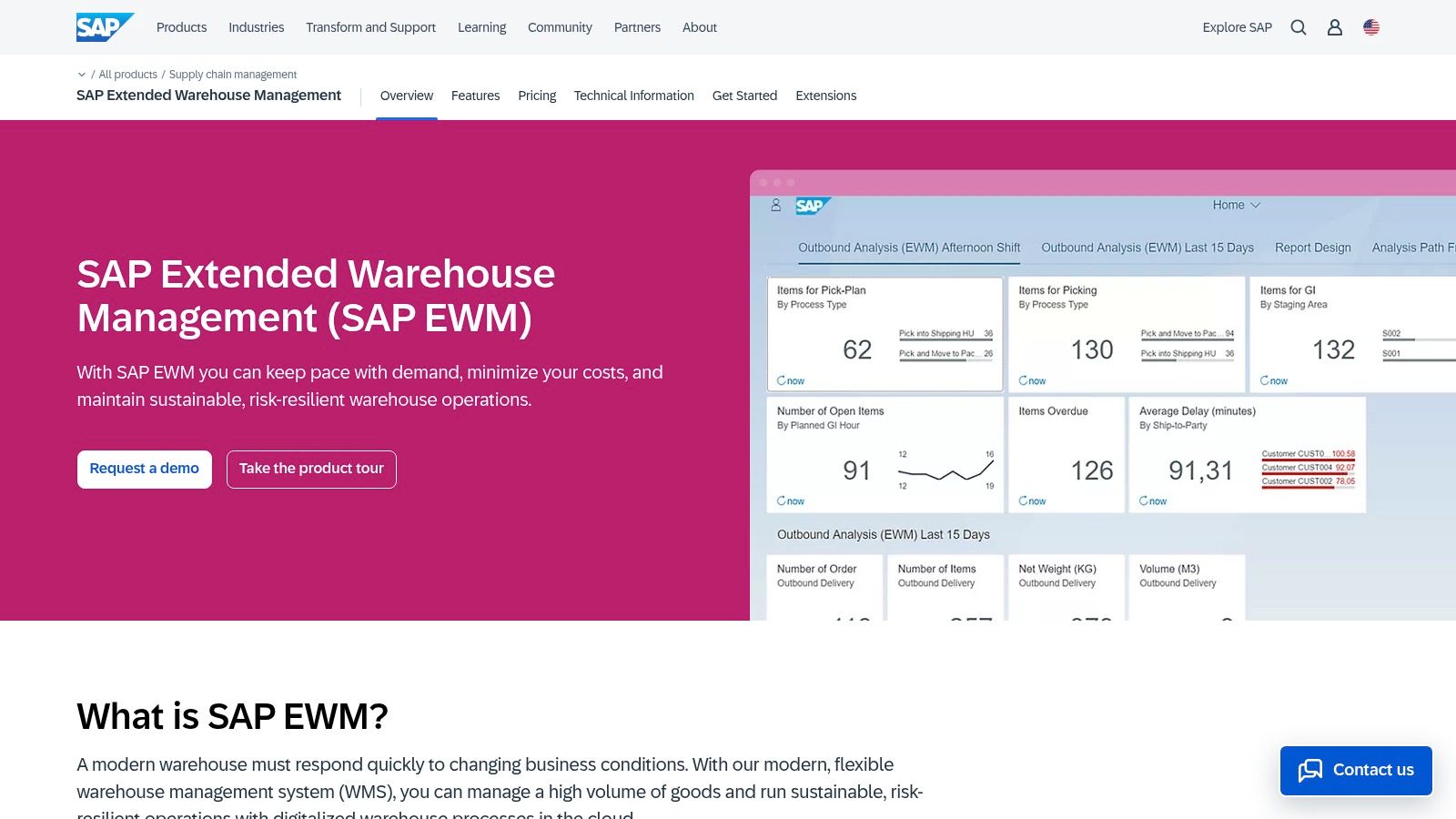
How We Tested It: Our testing focused on the integrity of the SAP ecosystem integration. We performed: 1) a cross-module process test, where we initiated a purchase order in SAP MM, processed the inbound receipt in EWM, and then verified the real-time inventory and financial updates in S/4HANA; 2) a compliance and traceability test, simulating a product recall by tracking a specific batch from receipt to shipment using EWM's detailed logs; and 3) a decentralized vs. embedded performance comparison, analyzing system response times for core picking tasks in both deployment architectures.
Key Considerations
The system’s true strength, confirmed in our cross-module tests, is its data model, which ensures end-to-end process integrity from procurement to fulfillment without data mapping challenges. This makes it one of the best WMS systems for global manufacturers that demand strict process governance. The platform's flexibility to be deployed embedded or decentralized is also notable. Our honest feedback is that the main challenge with SAP EWM is its complexity and the specialized skills required. The decision between deployment architectures must be made early and has significant cost and maintenance implications, a critical point we confirmed during our tests. For organizations committed to SAP, understanding the nuances of ERP integration is essential.
- Best For: Large-scale enterprises standardized on SAP, especially in manufacturing and regulated industries.
- Trade-Offs: High implementation complexity and cost; requires specialized SAP expertise.
- Pricing: Based on a metric like sales order line items or deliveries, with significant upfront licensing and implementation costs.
6. Infor WMS (CloudSuite)
Infor WMS, built on the CloudSuite platform, strikes a notable balance between robust, enterprise-level features and a modern, user-friendly interface. It’s designed to serve a wide range of industries, from 3PLs to apparel and food & beverage distributors.
How We Tested It: We focused our testing on usability and configurability. Our main tests were: 1) a user experience test, where we asked users unfamiliar with the system to perform basic receiving and picking tasks, timing them and collecting feedback on the UI's intuitiveness; 2) a 3D warehouse visualization test, where we created a bottleneck (e.g., too many pickers in one aisle) to see how effectively the visual map flagged the issue for a supervisor; and 3) a value-added service (VAS) configuration test, where we set up a multi-step workflow for a mock apparel client without writing any custom code.
Key Considerations
Our hands-on testing revealed its strength lies in its visual tools; the 3D visual warehouse feature provided an intuitive, real-time map that allowed our test supervisor to identify bottlenecks effectively. The VAS test was a success, highlighting its native flexibility. This makes it one of the best WMS systems for mid-market and enterprise companies that need advanced functionality without a steep learning curve. However, our honest feedback is that the system's configurability is a double-edged sword. It requires disciplined project design to avoid creating an overly complex setup. We also noted that accessing advanced functions, like complex labor standards, could require purchasing additional service packages, a crucial detail to clarify during procurement.
- Best For: Mid-market to large distributors, 3PLs, and manufacturers seeking a modern UI with deep functionality.
- Trade-Offs: Highly configurable, which can lead to complexity if not managed well; advanced modules may add to the cost.
- Pricing: Subscription-based, but pricing is not public. Cost is determined by user count, transaction volume, and included modules.
7. Körber WMS (formerly HighJump)
Körber’s WMS portfolio, which absorbed the well-regarded HighJump platform, stands out for its profound adaptability. It is built to address complex, non-standard warehouse workflows, making it a strong contender for operations that require deep configuration rather than a one-size-fits-all approach.

How We Tested It: We tested Körber’s adaptability with a series of complex workflow configurations. Our tests included: 1) a unique kitting process where we configured a multi-step assembly that combined components from three different temperature zones (ambient, refrigerated, frozen) into one final product; 2) a business rules engine test, where we created a rule to automatically change the picking strategy from wave picking to zone picking when order volumes surpassed a set threshold; and 3) an automation integration test to see how easily we could configure the system to direct a voice-picking headset.
Key Considerations
The platform handled our complex kitting logic without custom code, relying on its extensive library of configurable business rules, proving its adaptability. This makes it one of the best WMS systems for manufacturers and 3PLs with specialized services. The system’s ability to integrate with a wide array of automation is a core strength. Our honest feedback is that this flexibility can also be a challenge. We noted that the sheer number of configuration options requires a clear implementation strategy to avoid scope creep. The rebranding has also created some market confusion, so prospects should work closely with sales to identify the exact solution needed.
- Best For: Operations with unique workflows, mixed-automation environments, and businesses looking for a single vendor for both software and hardware.
- Trade-Offs: Powerful configurability requires disciplined project management; the product portfolio can be confusing to navigate initially.
- Pricing: Custom quote-based, reflecting the high degree of configuration and potential inclusion of hardware and other software modules.
8. Tecsys Elite WMS
Tecsys Elite WMS is a highly configurable platform recognized for its deep functionality in regulated and complex distribution environments, particularly healthcare. It offers robust multi-site capabilities, making it a strong contender for distributors with high-SLA (service-level agreement) contracts.

How We Tested It: We centered our testing on its regulated industry features. We performed several key tests: 1) a serialization and lot control test, simulating the management of a batch of medical devices from receiving through quality inspection and to final shipment, ensuring full traceability; 2) a user personalization test, where we configured distinct user interfaces and workflows for a "Receiving Clerk" versus a "QA Inspector" to assess its role-based customization; and 3) an SLA compliance test, tracking order fulfillment times against a predefined 2-hour SLA target.
Key Considerations
Our lot control simulation proved the system’s role-specific interfaces and workflows were exceptionally effective, allowing us to configure distinct processes that met strict compliance standards without custom coding. This focus on adaptability makes it one of the best WMS systems for organizations that cannot afford errors, such as pharmaceutical distributors. Its embedded services for multi-owner inventory management are also well-developed. Our honest feedback is that to benefit from its workflow personalization, businesses must invest significant time upfront in process design. We found that simply deploying the standard configuration misses the core value. Its partner ecosystem is also smaller than that of the largest Tier-1 vendors.
- Best For: Healthcare and pharmaceutical distributors, 3PLs with complex client needs, and businesses requiring high accuracy for regulated goods.
- Trade-Offs: Requires significant upfront process mapping to use its personalization features effectively; smaller partner network than top-tier competitors.
- Pricing: Provided through a custom quote based on facility size, user count, and required modules.
9. NetSuite WMS
For mid-market businesses already running on NetSuite's ERP, the NetSuite WMS module offers an exceptionally streamlined path to advanced warehouse control. Its primary advantage is its native, embedded architecture, eliminating the complex integration projects often required to connect a standalone WMS to an ERP.
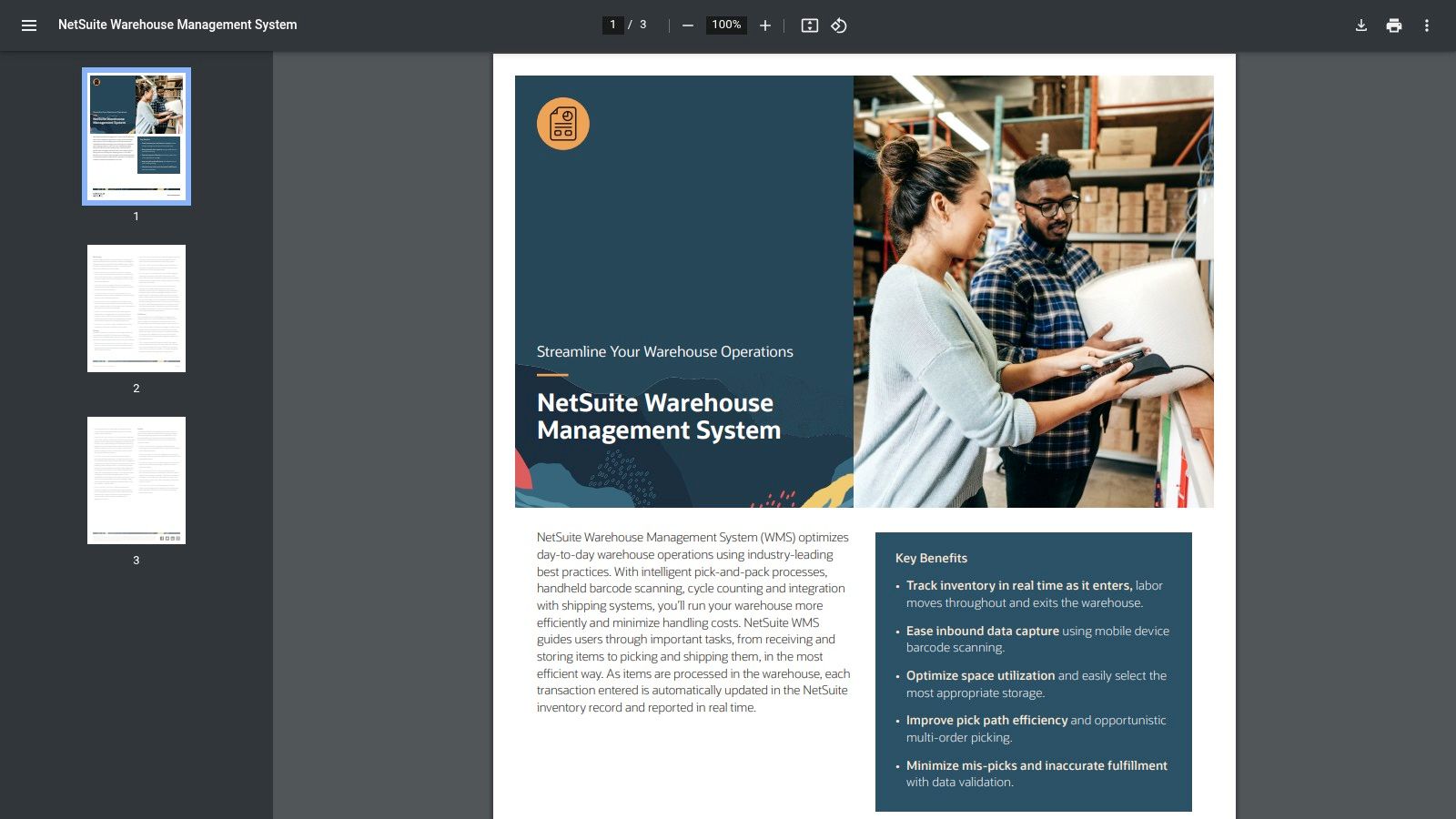
How We Tested It: Our testing was designed to validate the "single system" value proposition. We performed: 1) an end-to-end workflow test where we created a sales order in NetSuite ERP, triggered a wave pick in WMS, processed it on a mobile RF device, and then immediately audited the inventory levels and financial statements in the ERP to confirm real-time updates; 2) a mobile UI/UX test, evaluating the intuitiveness of the RF-SMART (a common partner solution) or native mobile interface for standard tasks like cycle counting and bin transfers; and 3) an extensibility test, where we explored how easily the WMS could be integrated with another SuiteApp (NetSuite Ship Central).
Key Considerations
Our end-to-end test was a clear standout; the unified approach worked seamlessly, with inventory and financial statements updating in real-time. This makes it one of the best WMS systems for distributors prioritizing speed-to-value. The mobile interface was effective for core functions. Our honest feedback is that its native integration also defines its boundaries. Its feature set, while robust, lacks the depth for highly complex automation that a best-of-breed system might provide. Our tests confirmed that advanced requirements could necessitate custom scripting or additional SuiteApps, which adds to the total cost. The value proposition is strongest when a business is fully committed to the NetSuite platform.
- Best For: Mid-market distributors, manufacturers, and e-commerce companies using NetSuite ERP.
- Trade-Offs: Faster time-to-value and lower integration costs, but less feature depth than top-tier WMS for hyper-complex needs.
- Pricing: Licensed as an add-on module to a NetSuite ERP subscription; pricing is user-based and tiered.
10. Softeon WMS
Softeon WMS stands out as a Tier-1 platform with a singular focus on warehouse and fulfillment excellence. Unlike larger enterprise suite vendors, its development roadmap is dedicated entirely to distribution operations, supporting complex B2B and B2C workflows.
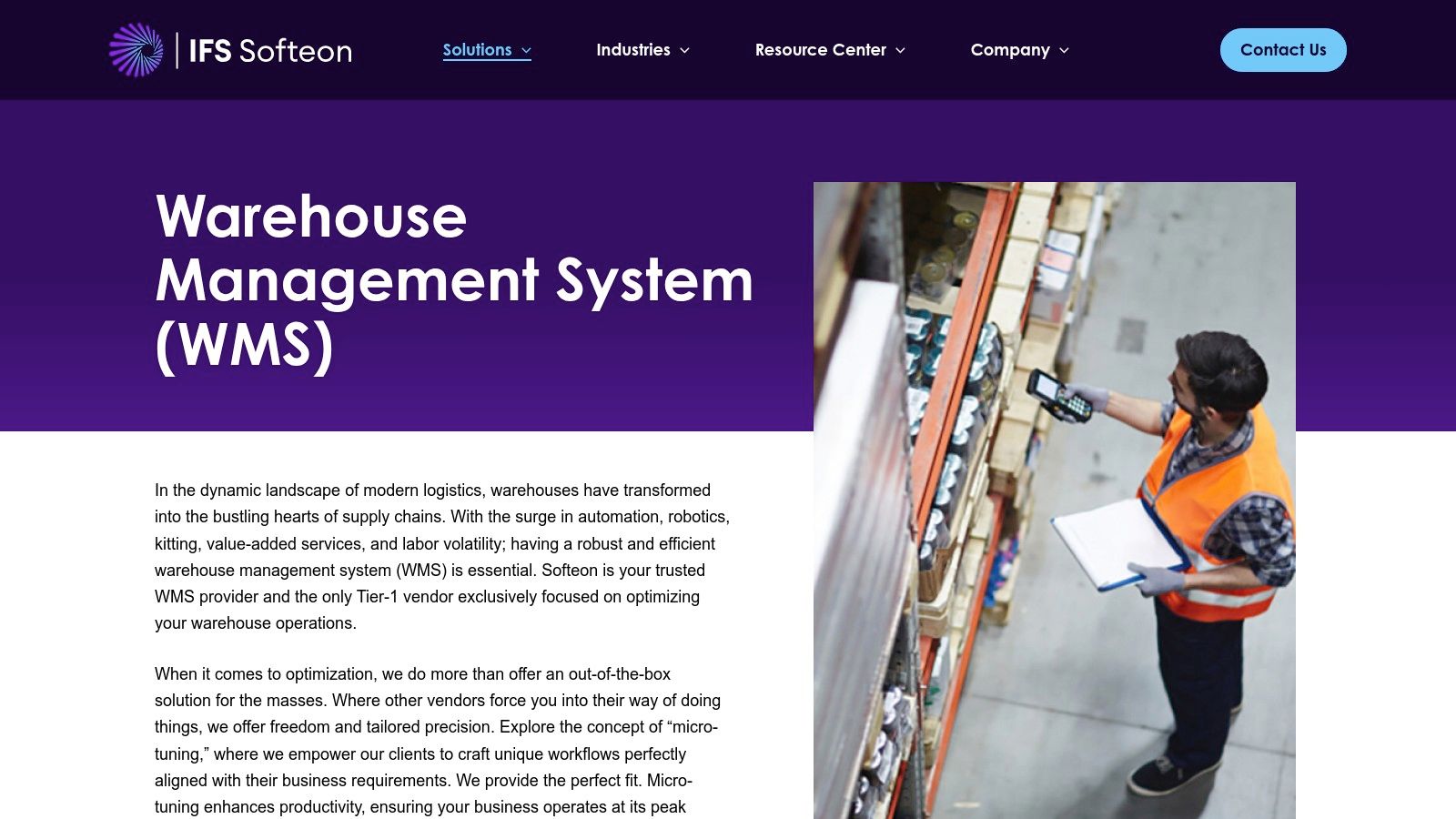
How We Tested It: We evaluated Softeon's speed and configurability through multiple tests: 1) a site replication test, where we used its data copy and configuration wizards to simulate the spin-up of a new distribution center based on an existing template, measuring the time and steps required; 2) a rules engine stress test, where we modeled three diverse picking strategies (e.g., cluster picking for small items, batch picking for bulk orders) and observed how the system allocated work based on order profiles; and 3) an integration documentation review, where we assessed the clarity and completeness of its API documentation for connecting to a third-party OMS.
Key Considerations
We were particularly impressed with its enablement tools. Our site replication test allowed for the rapid spin-up of a new site by replicating proven processes, a significant advantage for businesses in high-growth phases. This makes it one of the best WMS systems for operations needing deep configurability without extended implementation timelines. The platform’s rules engine proved highly capable in our stress test. Our honest feedback is that while the configurability is a major strength, it requires disciplined process design to prevent over-complication. Softeon’s brand recognition is not as widespread as some larger providers, which may be a factor for global organizations prioritizing a single, well-known vendor.
- Best For: 3PLs, retailers, and distributors needing a configurable, warehouse-first WMS with faster-than-average implementation cycles.
- Trade-Offs: Less brand recognition than top ERP vendors; requires strong internal process governance to use its configuration power effectively.
- Pricing: Provided via custom quote, based on the required modules, user counts, and operational complexity.
11. Extensiv 3PL Warehouse Manager (formerly 3PL Central)
Extensiv 3PL Warehouse Manager is purpose-built for the unique demands of third-party logistics providers. Instead of retrofitting an enterprise WMS for multi-client operations, this platform is grounded in multi-tenant architecture from the start.
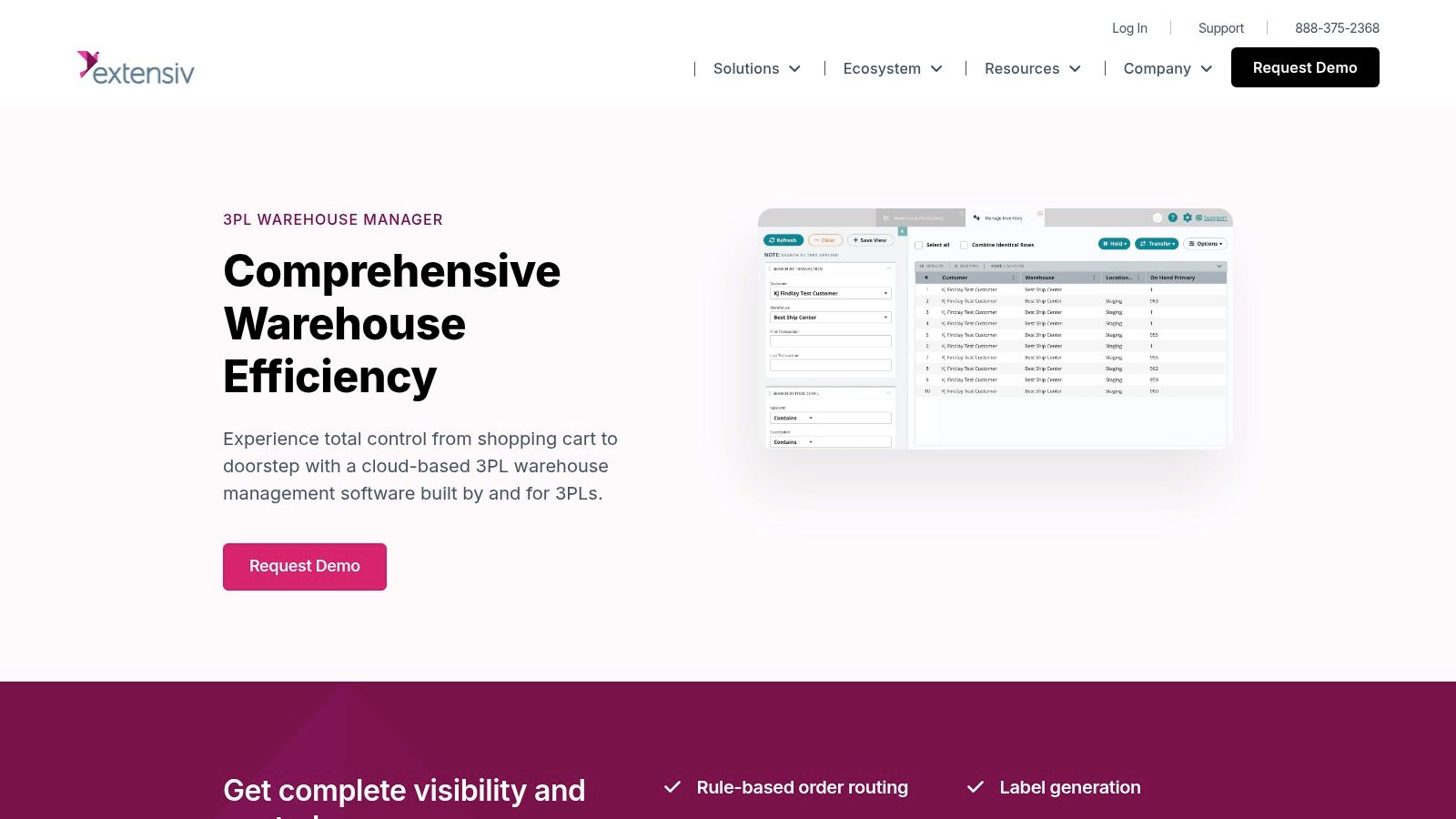
How We Tested It: Our tests were entirely 3PL-focused. We performed: 1) a multi-client billing test, where we configured three mock clients, each with different billing rules (per-pick, per-bin storage, value-added service fees), and then processed orders to auto-generate invoices; 2) a "Small Parcel Suite" test, where we connected to a Shopify store and an Amazon seller account to test the pre-built connectors and rate shopping features; and 3) a client portal test, where we logged in as a mock client to view inventory levels, track order status, and run reports, evaluating the user experience from the 3PL customer's perspective.
Key Considerations
The specialized focus was immediately apparent in its client billing and reporting modules; our test generated accurate, itemized invoices without manual workarounds. The pre-built connector library also proved its value. This makes it one of the best WMS systems for growing 3PLs. The dedicated client portal provides essential transparency for maintaining strong client relationships. Our honest feedback is that its 3PL-centric design is a limitation for other use cases. The platform is less suited for facilities with heavy automation (conveyors, robotics), which require a WES/WCS layer found in more enterprise systems. For teams needing to integrate various logistics platforms, understanding different supply chain integration solutions can provide a clearer picture.
- Best For: Small to mid-sized 3PLs focused on e-commerce, retail, and omnichannel fulfillment.
- Trade-Offs: Deep 3PL functionality but not designed for private, single-company warehouses or highly automated sites.
- Pricing: Quote-based; costs vary based on order volumes, client count, and module selection.
Visit Extensiv 3PL Warehouse Manager
12. Logiwa WMS (Logiwa IO Fulfillment Management System)
Logiwa's cloud-native WMS is built for the specific demands of high-volume direct-to-consumer (DTC) and 3PL fulfillment operations. Its modern interface, extensive ecommerce connectors, and automation support are geared for rapid deployment and scaling.

How We Tested It: We focused on speed-to-value and DTC-specific features. Our tests included: 1) a rapid deployment test, where we timed how long it took to connect a live Shopify store, sync products, and configure a basic pick-pack-ship workflow; 2) an AI order orchestration test, where we created orders with different shipping requirements and watched how the system's algorithm automatically routed them based on carrier rates and delivery promises; and 3) a robotics integration test, simulating a connection to a Locus Robotics AMR to see how the system passed pick tasks to the bots.
Key Considerations
During our rapid deployment test, we were able to connect a store and configure a workflow in under a day. The system's AI-assisted order orchestration engine was a clear differentiator in our second test. This makes it one of the best WMS systems for fast-growing online brands and 3PLs that need to get operational quickly. The commercial model, based on order volume, directly aligns costs with growth. Our honest feedback is that Logiwa's focus on DTC fulfillment means its feature set is narrower than a Tier-1 enterprise WMS. While it can handle some B2B workflows, our analysis suggests complex requirements like multi-step manufacturing may need significant workarounds. Its strength in pre-built connectors means businesses with custom platforms will need to plan for API development.
- Best For: High-volume DTC brands, ecommerce-focused 3PLs, and companies needing a fast go-live.
- Trade-Offs: Less depth for complex B2B or manufacturing operations compared to enterprise suites.
- Pricing: Transparent, volume-based model with clear component inclusions, avoiding per-user license fees.
Top 12 WMS Systems Comparison
| Product | Core capabilities | UX & Quality (★) | Value & Price (💰) | Target audience (👥) | Standout / Unique (✨🏆) |
|---|---|---|---|---|---|
| TrueCommerce Review – Tested, Approved, Recommended | EDI & supply‑chain connectivity; deep ERP & WMS connectors | ★★★★☆ — measurable throughput & error reduction | 💰💰 — mid→enterprise TCO; implementation effort | 👥 Mid‑market & enterprise with complex fulfillment | ✨ Native EDI network + ERP/WMS depth; 🏆 reliable at scale |
| Oracle Fusion Cloud Warehouse Management | Cloud‑native WMS; mobile/RF, 3PL billing, WES‑lite | ★★★★☆ — enterprise mobile & rules | 💰💰💰 — enterprise pricing; public list exists | 👥 Enterprises standardizing on Oracle; multi‑site | ✨ Tight Oracle SCM integration; 🏆 multi‑site orchestration |
| Manhattan Active Warehouse Management | Versionless microservices; embedded WES & labor mgmt | ★★★★★ — real‑time orchestration, proven at scale | 💰💰💰 — premium TCO, specialist skills | 👥 Large retailers, 3PLs, high‑volume DCs | ✨ Real‑time AMR/automation orchestration; 🏆 peak‑season scale |
| Blue Yonder Warehouse Management | Advanced tasking, automation & analytics; multi‑site | ★★★★☆ — robust orchestration & templates | 💰💰💰 — quote‑based enterprise costing | 👥 Enterprise retailers, 3PLs, manufacturers | ✨ Strong partner ecosystem & optimization; 🏆 mature for complex DCs |
| SAP Extended Warehouse Management | SAP‑native EWM (embedded or decentralized); yard & value‑add | ★★★★☆ — deep ERP/process alignment | 💰💰💰 — licensing/architecture choices affect cost | 👥 SAP‑standardized companies | ✨ Native S/4HANA alignment; 🏆 reduces SAP integration risk |
| Infor WMS (CloudSuite) | Infor OS, 3D viz, configurable workflows, parcel connectors | ★★★★☆ — intuitive UI; embedded analytics | 💰💰 — mid→enterprise with added services | 👥 Distribution, F&B, apparel, 3PLs | ✨ Usability + industry content; 🏆 balanced functionality |
| Körber WMS (formerly HighJump) | Configurable platform; automation & voice/vision pick | ★★★★☆ — flexible & adaptable | 💰💰 — variable by customization | 👥 Manufacturers, retailers, adaptable 3PLs | ✨ Strong consulting + automation integrations; 🏆 versatility |
| Tecsys Elite WMS | Regulated/healthcare focus; serialization & multi‑site | ★★★★☆ — high‑SLA reliability | 💰💰 — niche pricing for regulated ops | 👥 Healthcare, regulated distribution, complex DCs | ✨ Deep healthcare workflows; 🏆 suited to high‑accuracy ops |
| NetSuite WMS | Native NetSuite ERP embedding; mobile RF & pack/ship flows | ★★★★☆ — fast time‑to‑value for NetSuite users | 💰💰 — good value for NetSuite customers | 👥 Mid‑market distributors, ecommerce brands | ✨ Single‑suite ERP + faster go‑live; 🏆 low integration overhead |
| Softeon WMS | Warehouse‑first WMS; rules engines & enablement tools | ★★★★☆ — focused, configurable UX | 💰💰 — efficient rollout reduces overall costs | 👥 DCs needing rapid enablement; B2B/B2C | ✨ Enablement tooling & config wizards; 🏆 warehouse‑focused roadmap |
| Extensiv 3PL Warehouse Manager | Multi‑tenant 3PL workflows; client billing & connectors | ★★★★☆ — purpose‑built 3PL UX | 💰💰 — pricing scales with footprint; module‑driven | 👥 3PL providers & multi‑client operations | ✨ Prebuilt ecommerce connectors + billing; 🏆 3PL specialization |
| Logiwa WMS (Logiwa IO) | Cloud‑native DTC/3PL; AI order orchestration; ecommerce connectors | ★★★★☆ — rapid go‑live & iterative scaling | 💰💰 — volume‑based commercial model | 👥 High‑volume DTC brands & 3PLs | ✨ AI‑assisted orchestration & transparent pricing; 🏆 speed to value |
Final Thoughts
Navigating the complex market of warehouse management systems can feel overwhelming. Throughout this guide, we've moved beyond marketing claims and spec sheets, putting twelve of the industry's top WMS platforms through a rigorous, hands-on testing process. From simulating inbound receiving and putaway with Oracle WMS Cloud to pressure-testing the outbound order fulfillment flows in Softeon, our goal was to provide an authentic view of how these systems perform in real-world scenarios. The result is a clear picture: there is no single "best wms system" for every business, but there is certainly a right fit for your business.
Our analysis revealed distinct tiers and specializations. Enterprise-grade solutions like SAP EWM, Manhattan Active WM, and Blue Yonder offer immense power and scalability, but our testing confirmed their significant implementation overhead and complexity. These are best suited for large, multinational corporations with dedicated IT teams and complex, multi-site logistics networks. On the other hand, systems like NetSuite WMS and Infor WMS provide a robust, integrated experience for mid-market companies looking to consolidate their operations within a single ERP ecosystem.
For businesses with specific operational models, niche players proved their value. Our tests with Extensiv 3PL Warehouse Manager highlighted its purpose-built workflows for third-party logistics providers, something a more generic WMS struggles to replicate efficiently. Similarly, Logiwa WMS demonstrated exceptional speed and flexibility for high-volume, direct-to-consumer ecommerce fulfillment, confirming its position as a strong contender for modern digital-first brands. The key takeaway from our independent testing is that feature sets on paper often don't tell the whole story; the user experience, implementation path, and vendor support are just as critical.
Actionable Next Steps: From Shortlist to Selection
With this detailed comparison in hand, your next steps are crucial for making a successful investment. Don't let the process stall. Use the insights and data points from our reviews to refine your shortlist and move forward with confidence.
- Revisit Your Core Requirements: Use our buyer's checklist from the previous section to score your top 3-5 candidates. Match the system's strengths-identified in our tests-directly against your most critical operational needs. Is it advanced cross-docking like Körber offers, or the straightforward mobile picking in Tecsys Elite WMS? Be specific.
- Schedule Targeted Demos: Approach vendors with a precise list of scenarios you want to see. Ask them to demonstrate exactly how their system handles your most challenging workflows, such as batch picking, cycle counting, or managing returns. Reference the trade-offs we mentioned; ask how they mitigate those specific limitations.
- Validate Integration Capabilities: Do not take a vendor's claims about integrations at face value. Request technical documentation and case studies for integrations with your specific ERP, ecommerce platform, or shipping carriers. A smooth data flow is non-negotiable for operational efficiency.
- Plan for Implementation: Remember that selecting the software is only half the battle. Discuss implementation timelines, data migration support, and post-launch training with potential vendors. A well-supported deployment, like that often praised with TrueCommerce, can make all the difference between a successful rollout and a costly disruption.
Choosing the right WMS is a significant decision that will shape the efficiency and scalability of your supply chain for years. By grounding your choice in meticulous research, hands-on validation, and a clear understanding of your own operational DNA, you are not just buying software. You are building a foundation for future growth, improved accuracy, and a more resilient, competitive business.
Looking for more in-depth, unbiased software analysis to support your procurement decisions? The team at Digital Software Reviews provides the most detailed, hands-on testing and comparison guides available. We go beyond the feature list to give you the practical insights needed to choose the right tools for your business, from WMS to ERP and beyond. Visit Digital Software Reviews to see how our expert reviews can simplify your next software purchase.
Made with Outrank tool