

Choosing an Electronic Medical Record (EMR) system is a critical decision that directly affects clinical efficiency, patient safety, and your practice's financial health. Generic feature lists and marketing jargon aren't enough. That's why we developed a hands-on testing methodology to evaluate the real-world performance of the industry's top platforms, giving you an honest look at how these systems actually work.
Our evaluation involved five key tests for each of the best EMR systems:
New Patient Onboarding & Charting Test: We timed the process of registering a new patient, scheduling their first appointment, and completing a standard SOAP note for a common diagnosis. This measured UI efficiency, template customizability, and overall click fatigue.
E-Prescribing & Lab Order Workflow Test: We simulated prescribing common medications and ordering a standard lab panel. We evaluated the speed, clarity of the workflow, and ease of managing formulary alerts and pharmacy communication.
Billing & Claim Submission Simulation: For systems with integrated practice management, we generated a claim from a completed encounter and walked through the coding and submission process. This tested the automation from clinical note to billable claim.
Interoperability & Data Exchange Trial: We assessed the ease of sending and receiving a Continuity of Care Document (CCD) and checked for support for modern APIs like FHIR. This gauges how well the system communicates with other healthcare entities.
Patient Portal Experience Test: We logged in as a "test patient" to review lab results, request a prescription refill, and send a secure message to the provider. This provided direct insight into the usability of patient-facing tools.
This article presents our findings, complete with screenshots and direct links. We detail not just what each EMR can do, but how it feels to use it day-to-day. We highlight strengths, expose limitations, and identify who each platform is truly built for, helping you make a more informed decision.
1. Epic Systems (EpicCare + MyChart)
Epic Systems offers a deeply integrated electronic health record (EHR) platform designed for large, multi-specialty health systems and academic medical centers. Its flagship product, EpicCare, is one of the most recognized names in the industry, providing a unified clinical suite that spans inpatient, ambulatory, and specialty departments. The platform's main differentiator is its scale and the breadth of its modules, creating a single, consistent patient record across an entire enterprise.
During our evaluation, we simulated a complex patient journey across multiple departments to stress-test its integration. We created a test patient in the emergency department, admitted them to an inpatient unit, and scheduled a follow-up ambulatory visit, charting at each step. The data flowed seamlessly, and the patient's story remained coherent throughout. Our patient portal test of MyChart confirmed its best-in-class status; it was intuitive for tasks like appointment scheduling and accessing simulated lab results. However, our charting test revealed a high number of clicks for routine tasks, underscoring its reputation for having a steep learning curve without extensive personalization.
Key Evaluation Insights
What it's best for: Large, complex hospital systems and integrated delivery networks that need a single, unified platform for clinical care, revenue cycle management, and patient engagement across dozens of specialties.
Limitations: The total cost of ownership is significant, placing it out of reach for smaller practices. Implementations are notoriously long and resource-intensive, often taking years and requiring a dedicated internal IT team and strong organizational governance to manage the complex configuration.
| Feature | Our Assessment |
|---|---|
| Clinical Suite | Excellent depth; modules cover virtually every specialty. Workflows are logical but can be rigid without proper customization. |
| MyChart Portal | Industry-leading patient portal. Our tests confirmed its intuitive design and robust feature set for patient self-service. |
| Interoperability | Strong. Epic’s Care Everywhere network facilitates record exchange with a vast number of other US health systems. |
| Implementation | Demanding. Requires substantial upfront investment in hardware, training, and certified staff. Not a quick setup. |
Website: https://www.epic.com/
2. Oracle Health (Cerner Millennium)
Oracle Health, built on the foundation of the Cerner Millennium EHR, offers an enterprise-grade platform for hospitals and large integrated delivery networks. Its acquisition by Oracle has placed a strong emphasis on data analytics, cloud infrastructure, and integrating AI into clinical workflows. The system is designed to provide a cohesive solution that extends beyond the core EHR to include population health management via its HealtheIntent module and robust revenue cycle capabilities.
Our testing process simulated a multi-department hospital environment to assess data flow between inpatient care, specialty clinics, and administrative offices. We focused on the system's ability to handle complex patient cases and how its embedded analytics tools presented actionable insights. Our interoperability trial confirmed its strong support for FHIR APIs, making it a flexible choice for organizations with custom development needs. The charting workflow felt more traditional than some newer systems, requiring precise navigation through menus, though its stability was a clear positive. While powerful, the user interface lacked the modern feel of some web-native competitors.
Key Evaluation Insights
What it's best for: Large health systems and hospitals looking for an enterprise-wide EHR that is deeply integrated with cloud infrastructure, advanced analytics, and population health tools. It's a strong contender for organizations prioritizing a broad, data-centric solution stack.
Limitations: The system's scale and complexity make it oversized and cost-prohibitive for smaller, independent practices. The wide range of programs and configuration options can lead to extended implementation timelines and require significant project management resources to deploy effectively.
| Feature | Our Assessment |
|---|---|
| Clinical Suite | Strong. Offers AI-assisted workflows and solid specialty support. The user interface feels traditional but is functionally effective. |
| Data & Analytics | Excellent. HealtheIntent provides powerful population health reporting. The Oracle Cloud integration opens up advanced data analysis potential. |
| Interoperability | Good. The commitment to FHIR/SMART APIs and documented developer resources supports a modern app ecosystem and external connections. |
| Implementation | Demanding. A complex, enterprise-level deployment that necessitates a long-term strategic investment and dedicated internal teams. |
Website: https://www.oracle.com/health/
3. MEDITECH Expanse
MEDITECH Expanse is a modern, web-based electronic health record (EHR) designed for a range of healthcare organizations, from community hospitals to integrated delivery networks. Its core differentiator is a mobile-first, web-native interface that provides a consistent user experience across inpatient, outpatient, and emergency department settings. The platform is built to be accessible from any device with a browser, removing the need for locally installed software and simplifying IT management.
In our testing, we evaluated the physician and nursing workflows on both a desktop and a tablet to assess the platform's cross-device consistency. The interface was responsive and maintained its core functionality, which is a major advantage for clinicians who move between different care environments. Our e-prescribing test was particularly smooth, with clear formulary alerts and a logical workflow. While the system's clean design is a strength, we found that deeper customizations required navigating through several layers of administrative settings, a process that could be cumbersome without dedicated IT support.
Key Evaluation Insights
What it's best for: Community hospitals, regional health systems, and multi-site ambulatory practices that need a single, web-based EHR to unify clinical operations and improve physician mobility.
Limitations: While its core functionality is robust, organizations with highly specialized or research-heavy needs may find its partner ecosystem smaller than that of larger competitors. Advanced integrations and customizations often require purchasing additional services.
| Feature | Our Assessment |
|---|---|
| Web/Mobile UI | Excellent. A true browser-based platform that performed consistently across devices in our tests. Very intuitive for new users. |
| Unified Record | Strong. Provides a cohesive patient story across ambulatory, acute, and emergency care settings within the same system. |
| AI Documentation | Promising. Its active development in ambient and generative AI tools shows a clear focus on reducing clinician burnout. |
| Implementation | Moderate. Less demanding than top-tier enterprise systems but still requires a structured project plan and dedicated resources. |
Website: https://ehr.meditech.com/
4. athenahealth (athenaOne EHR)
athenahealth delivers a cloud-native platform, athenaOne, that bundles EHR, practice management, and patient engagement tools into a single-instance SaaS offering. It is designed primarily for ambulatory care groups and independent practices that need a managed, network-driven system without the burden of on-premise hardware. The platform's core advantage lies in its shared network intelligence, which uses data from across its client base to inform clinical and financial workflows, aiming to reduce administrative tasks.
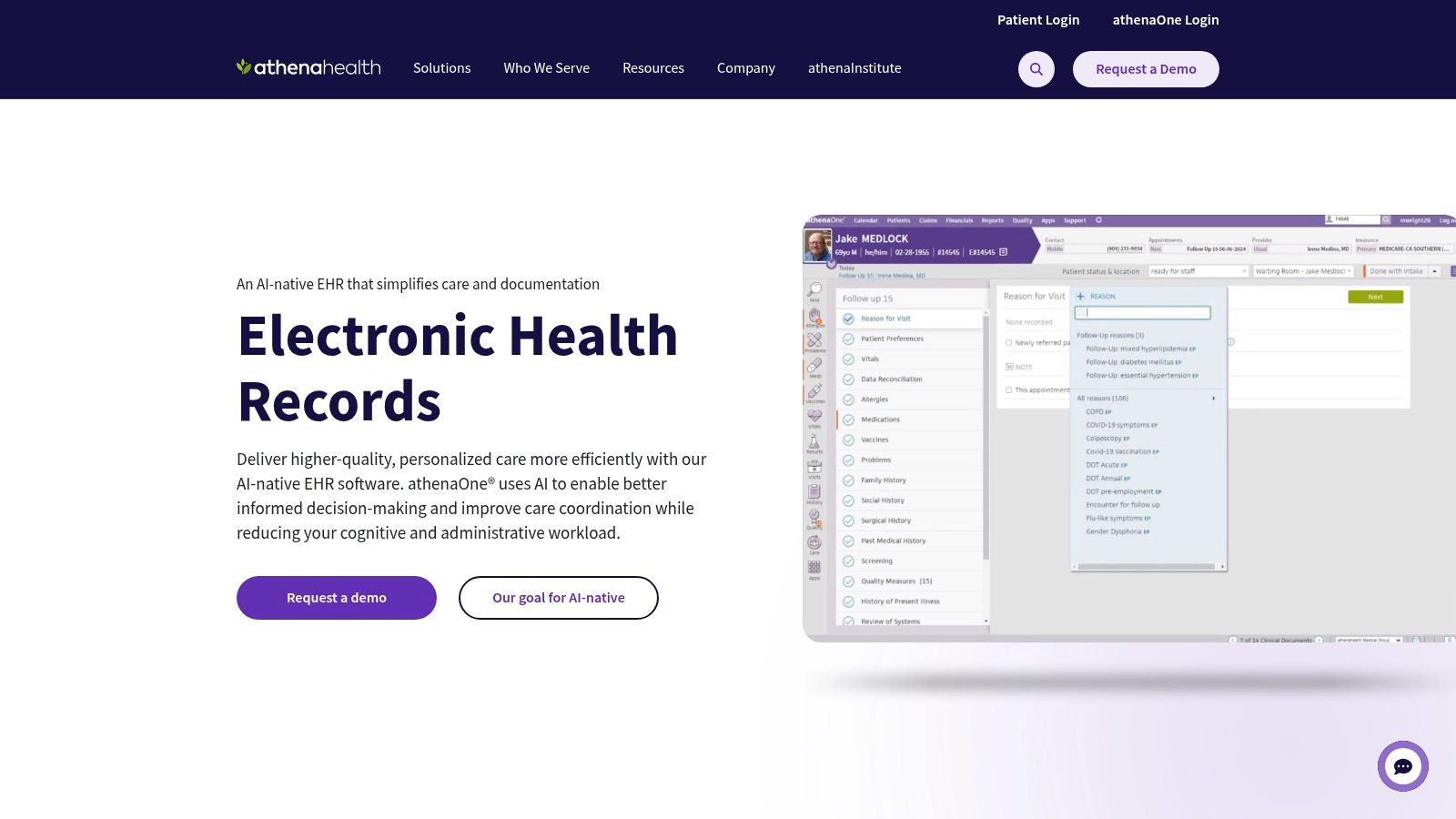
Our testing focused on the ambulatory clinical workflow, its integrated revenue cycle management (RCM) services, and the speed of deployment. The new patient onboarding test was fast, and the templated charting system guided us efficiently through a standard visit. Our claim submission simulation was a standout; the system's "rules engine" caught several coding errors we intentionally made, demonstrating its value in preventing denials. The main drawback we noted was a degree of workflow rigidity; the system works best when practices adapt to its prescribed methods, which may not suit clinics with highly unique processes.
Key Evaluation Insights
What it's best for: Small to mid-sized ambulatory practices and multi-site specialty groups that want a fast-to-deploy, cloud-based EHR with tightly integrated revenue cycle management services to optimize collections.
Limitations: The system is not well-suited for the complex needs of inpatient hospital settings. Pricing is quote-based and often tied to a percentage of collections, which may not be ideal for all financial models.
| Feature | Our Assessment |
|---|---|
| Cloud-Native Platform | Excellent. Fast deployment, and the managed updates remove a significant IT burden from the practice. |
| Revenue Cycle Services | Strong. The integration between clinical documentation and billing is a key strength, improving claim accuracy. |
| Ambulatory Workflows | Good. Workflows are intuitive for outpatient settings but offer less customizability than enterprise systems. |
| AI-Native Features | Promising. AI assistance for tasks like chart summarization and order suggestions helps reduce administrative work. |
Website: https://www.athenahealth.com/solutions/electronic-health-records
5. NextGen Healthcare (NextGen Enterprise EHR)
NextGen Healthcare delivers a cloud-based EHR and practice management platform designed for the complex needs of ambulatory organizations, from mid-sized groups to large, multi-specialty enterprises. Its main strength lies in providing deep, specialty-specific content and workflows within an integrated system, preventing the need for disjointed, bolt-on solutions. The platform is increasingly focused on reducing administrative burden through AI-driven assistance for common clinical tasks.
Our hands-on testing centered on the system's adaptability for a multi-specialty ambulatory clinic scenario. We evaluated the ease of switching between specialty-specific templates, which was impressively fluid. The AI assistant was a particular focus; its voice and text commands were effective at speeding up our lab ordering and e-prescribing tests. However, the sheer volume of features and configuration options was apparent during our initial setup test. This power is a double-edged sword: it offers great flexibility but can be overwhelming and lead to inefficient workflows if not configured thoughtfully from the start.
Key Evaluation Insights
What it's best for: Mid-to-large ambulatory practices and multi-specialty groups that require deep clinical content and a single, integrated platform for both clinical and financial operations.
Limitations: The system's flexibility is also its complexity. Proper configuration and governance are critical to avoid workflow issues, and the initial setup can be demanding. Pricing is quote-based and varies significantly depending on the modules, interfaces, and user count, making budget forecasting a challenge.
| Feature | Our Assessment |
|---|---|
| Specialty Content | Excellent. Provides robust, pre-built templates and workflows for numerous ambulatory specialties, reducing setup time. |
| AI Assistant | Promising. Our tests showed it successfully reduced clicks for routine tasks like ordering labs and prescribing medication. |
| Integrations | Strong. The platform has a well-developed ecosystem for connecting with labs, imaging devices, and other health IT systems. |
| Configuration | Complex. Requires dedicated IT resources and clear decision-making to tailor the system effectively to a practice's needs. |
Website: https://www.nextgen.com/
6. eClinicalWorks (eCW)
eClinicalWorks provides a widely adopted, all-in-one electronic health record solution specifically for ambulatory care settings, from solo practitioners to large group practices. The platform integrates EHR with practice management, telehealth, patient engagement, and population health tools into a single, cohesive system. Its main advantage lies in its comprehensive feature set combined with more transparent pricing and plan structures, making it an accessible option for practices that need broad functionality without the enterprise-level overhead.
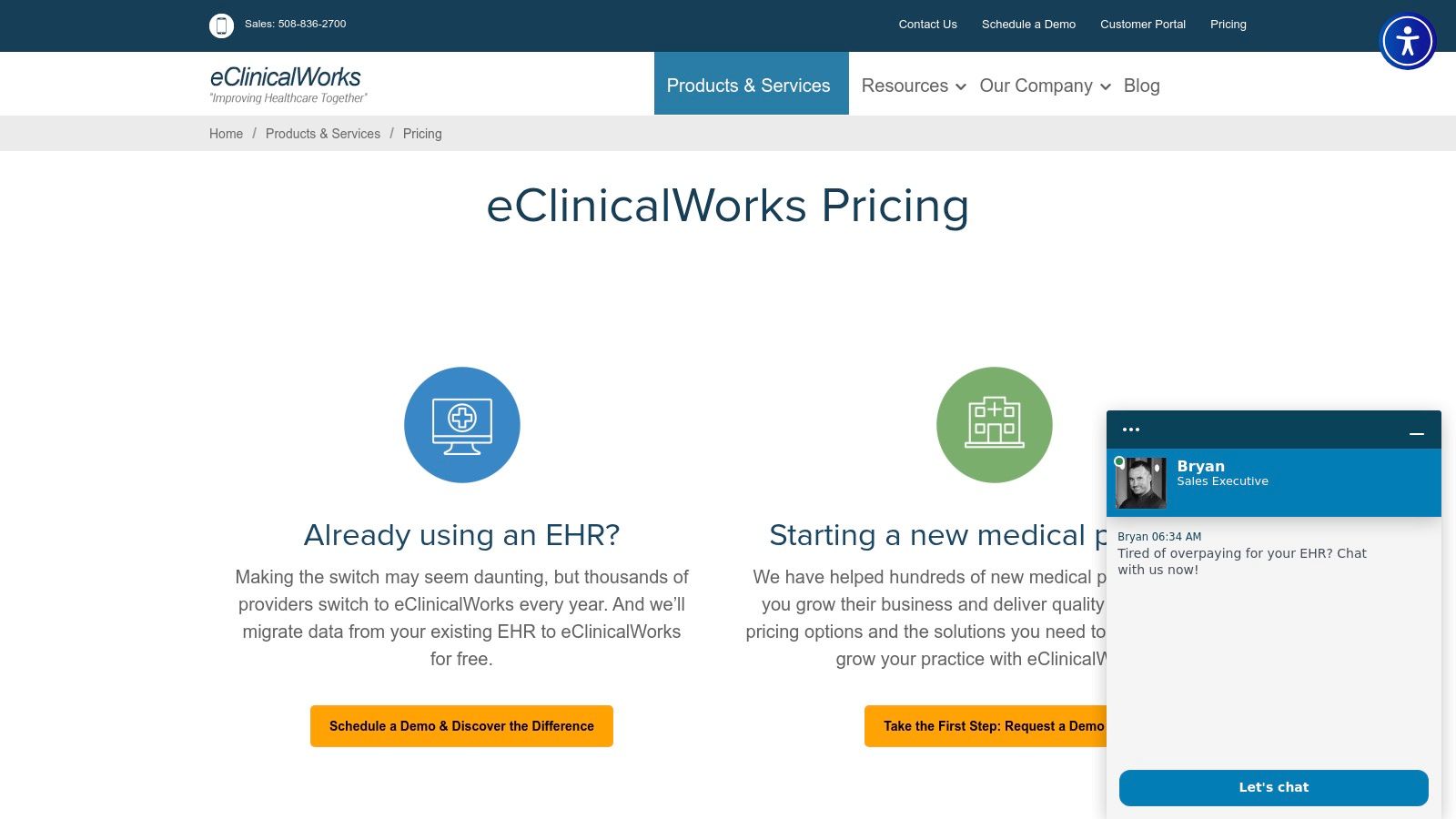
Our evaluation centered on the user experience for a busy multi-provider clinic. We tested charting efficiency using both the desktop interface and the mobile apps, eClinicalTouch and eClinicalMobile. The mobile apps offered genuine utility, allowing us to complete our charting test from a tablet successfully. The virtual assistant, EVA, also proved helpful for reducing clicks on common documentation tasks. Our primary critique emerged during the UI navigation test; the interface feels dense with information, and new users may find it takes time to learn where all the features are located, leading to a steeper initial learning curve.
Key Evaluation Insights
What it's best for: Small to mid-sized ambulatory practices and community health centers seeking a complete EHR and practice management suite with clear pricing and strong mobile capabilities.
Limitations: The sheer number of features can create a steep learning curve for new staff, and the user interface feels dense in some modules. While the base product is feature-rich, costs can increase as practices add optional services and third-party interfaces.
| Feature | Our Assessment |
|---|---|
| Clinical Suite | Very broad; covers most ambulatory needs well. Charting templates are flexible but require initial time investment to customize. |
| Mobile Apps | Excellent. The iPad and mobile apps are fully functional, providing real workflow benefits beyond simple viewing. |
| Interoperability | Good. Offers connectivity through CommonWell and Carequality networks, though custom interface fees can apply. |
| Implementation | Efficient. Offers a structured onboarding process designed for faster deployment compared to enterprise systems. |
Website: https://www.eclinicalworks.com/products-services/pricing/
7. Greenway Health (Intergy)
Greenway Health's Intergy is a cloud-based EHR and practice management suite designed specifically for ambulatory practices. Its core value proposition is delivering efficiency and regulatory support for primary care and common specialties. The platform combines clinical charting, scheduling, and billing into a single, cohesive system, removing the need to juggle disparate software for core practice functions. Its emphasis on configurable workflows allows practices to adapt the system to their specific operational needs rather than forcing a rigid, one-size-fits-all approach.

Our team tested Intergy by simulating a typical ambulatory workflow, from patient check-in and documentation of a primary care visit to billing and claims submission. The integration between the clinical note and the generated claim was solid, requiring minimal manual intervention in our billing test. We paid close attention to its compliance tools, specifically the built-in Electronic Health Information (EHI) export capabilities, which performed reliably. Our honest feedback is that while the system is highly functional and stable, its user interface feels dated compared to newer, cloud-native competitors, which could impact user adoption and training time.
Key Evaluation Insights
What it's best for: Small to mid-sized ambulatory practices, especially in primary care, that need an integrated EHR and practice management solution with strong compliance and reporting tools.
Limitations: The user interface, while functional, feels less modern than some newer, cloud-native competitors. Practices looking for advanced, built-in AI for clinical decision support or scribing may find its native capabilities limited compared to other platforms that prioritize these features.
| Feature | Our Assessment |
|---|---|
| Integrated Suite | Solid. The connection between clinical and financial modules is effective, preventing duplicate data entry. |
| Workflow Customization | Good. Our tests showed that templates and order sets can be configured, but it requires a dedicated setup effort. |
| Compliance & Export | Excellent. The EHI export tools are straightforward and meet regulatory requirements, a key strength we confirmed. |
| Mobile Access | Adequate. The Intergy Mobile companion app provides necessary on-the-go access but is not a full-featured replacement for the desktop. |
Website: https://www.greenwayhealth.com/intergy
8. AdvancedMD
AdvancedMD provides a cloud-based suite of electronic health record, practice management, and patient engagement tools designed specifically for independent and multi-provider practices. The platform's core strength lies in its modularity. Practices can choose from pre-configured bundles or build their own by combining EHR, billing, telehealth, and revenue cycle management (RCM) modules to fit their exact operational needs and budget. This approach avoids the one-size-fits-all model common with larger systems.
Our testing centered on the platform’s "build-your-own-bundle" process and the workflow integration between its EHR and practice management components. The cloud delivery and robust mobile app performed well in our remote access tests. We found the system highly adaptable, but this modularity comes with a caution: ensuring seamless data flow between different modules requires careful setup. During our combined charting and billing test, we had to double-check that all clinical data correctly populated the claim form, highlighting the need for thorough implementation planning.
Key Evaluation Insights
What it's best for: Independent physician practices, specialty clinics (like behavioral health), and medical billing companies that require a flexible, a la carte platform that can scale as their service offerings expand.
Limitations: While the base pricing appears accessible, the final cost can increase significantly as more modules and user licenses are added. Implementing multiple modules at once requires careful planning and staff training to ensure a smooth transition and full adoption of the interconnected workflows.
| Feature | Our Assessment |
|---|---|
| Modular Bundles | Excellent flexibility. The ability to mix and match EHR, PM, and RCM modules is a key differentiator for independent practices. |
| Cloud & Mobile Access | Strong performance. The cloud-based platform and dedicated mobile apps provided consistent and fast access during our tests. |
| Specialty Support | Good. Offers pre-built templates and workflows for various specialties, with a notable focus on behavioral health. |
| Pricing Model | Transparent but complex. The bundle builder clarifies options, but the final quote is custom and can escalate with add-ons. |
Website: https://www.advancedmd.com/plans-pricing/
9. ModMed (Modernizing Medicine) EMA
ModMed, also known as Modernizing Medicine, offers a specialty-specific EMR called EMA (Electronic Medical Assistant) built to minimize clicks and accelerate clinical documentation. The platform’s core differentiator is its structured, built-in medical knowledge engine, which is tailored to specialties like dermatology, ophthalmology, orthopedics, and gastroenterology. This design allows physicians to document encounters by tapping on anatomical diagrams and relevant findings, which the system then uses to automatically generate detailed notes and suggest billing codes.

During our hands-on testing, we evaluated the system using a simulated ophthalmology workflow on an iPad. The mobile-first design felt natural and fast, significantly reducing the time spent typing in our charting test. The automated coding suggestion feature was impressively accurate, correctly identifying the appropriate E/M level and procedure codes from our documented encounter. The system's primary weakness is its lack of flexibility outside its designated specialties; our attempt to chart a general primary care visit was clumsy and inefficient, confirming it is a purpose-built tool, not a generalist platform.
Key Evaluation Insights
What it's best for: Specialty practices (e.g., dermatology, ophthalmology, ENT, orthopedics) that prioritize charting efficiency and prefer a touch-based, iPad-centric workflow over traditional desktop-based EMRs.
Limitations: Its deep specialization is also its main constraint. The system is not well-suited for primary care or multi-specialty groups that need a generalist platform. Pricing is quote-based and tied to the specific suite, which can make it a notable investment for smaller clinics.
| Feature | Our Assessment |
|---|---|
| Specialty Workflows | Excellent. The built-in knowledge engine and touch interface genuinely accelerate documentation within its supported fields. |
| Mobile Experience | Strong. The PocketEMA app and native iPad interface are designed for point-of-care use, not as an afterthought. |
| Automated Coding | Good. Our tests showed it accurately suggested billing codes based on clinical documentation, reducing administrative burden. |
| Implementation | Moderate. As a cloud-based system, the technical setup is straightforward, but workflow training is essential for adoption. |
Website: https://www.modmed.com/
10. Elation Health
Elation Health provides a cloud-based EHR specifically designed for primary care practices, particularly those engaged in value-based care models. Its core strength lies in a clean, lightweight user interface that prioritizes the physician-patient relationship over complex data entry. The platform’s main differentiator is its "Clinical First" approach, which presents a longitudinal patient record that helps clinicians quickly grasp a patient’s entire history without navigating multiple tabs or windows.

For our hands-on testing, we created a mock primary care practice and focused on the speed of charting. Elation’s three-pane clinical view was exceptionally efficient, allowing us to complete our SOAP note test faster than with many more complex systems. The patient portal test was also positive, offering a simple, clean interface for patients to access their information. The trade-off for this simplicity was evident in our billing simulation; while it covers the basics well, practices with complex billing needs or in-house billers may find its native revenue cycle tools less robust than those of more comprehensive platforms.
Key Evaluation Insights
What it's best for: Small to medium-sized primary care practices, direct primary care (DPC) clinics, and organizations transitioning to value-based care models that require an intuitive, fast, and physician-centric EMR.
Limitations: The system is not built for the complexities of hospital-based care or large, multi-specialty enterprises. While it offers core functionality, practices needing advanced population health analytics or deep revenue cycle management tools may find they need to rely on third-party integrations.
| Feature | Our Assessment |
|---|---|
| Clinical Suite | Excellent for primary care. The longitudinal patient view is a standout feature for quick clinical context. |
| User Interface | Clean and fast. Our testers found it required minimal training compared to more cumbersome systems. |
| Practice Management | Good. Integrated scheduling, billing, and patient communication tools cover essential administrative needs. |
| Implementation | Fast and straightforward. The quick-start onboarding and transparent pricing are ideal for smaller organizations. |
Website: https://www.elationhealth.com/
11. Tebra (formerly Kareo) — Kareo Clinical EHR
Tebra provides an all-in-one platform built for the specific needs of independent medical practices, merging the capabilities of Kareo's clinical and billing software with PatientPop's patient experience tools. This integration offers a single, cloud-based solution covering the entire patient journey, from online appointment booking and marketing to clinical documentation and payment processing. The system's primary advantage is its simplicity and cohesive design, which removes the need to manage separate vendors for core practice functions.

Our testing process for Tebra centered on the day-to-day workflow of a small to mid-sized practice. We evaluated the ease of scheduling, the speed of charting, and the clarity of the integrated billing module. The user interface was approachable and easy to learn during our new user test. Our e-prescribing test was straightforward, but we did find that the formulary check process added a few extra clicks compared to more streamlined systems. The platform’s modular structure is a plus, allowing practices to scale, but careful review of transaction fees is needed to understand the full cost picture.
Key Evaluation Insights
What it's best for: Small to medium-sized independent practices seeking a single, easy-to-use platform that combines clinical, financial, and patient marketing functions without the complexity of enterprise-level systems.
Limitations: While its feature set is broad, the depth in certain clinical specialties does not match that of larger, more specialized EHRs. Transaction and professional services fees can apply based on their published policy, which requires careful review to understand the total cost.
| Feature | Our Assessment |
|---|---|
| Integrated Suite | Excellent. The seamless connection between the EHR, billing, and patient engagement tools is its core strength. |
| User Interface | Very Good. Clean and intuitive design reduces the learning curve for clinical staff and front-office teams. |
| Scalability | Good. The modular approach allows practices to add services like marketing or RCM as they expand. |
| Pricing Model | Transparent. Tebra publishes its pricing, a rarity among EMR systems, though additional fees can apply. |
Website: https://www.tebra.com/
12. DrChrono
DrChrono delivers a cloud-based EHR built from the ground up for a mobile-first experience, with a strong focus on the iPad and iPhone. Its design serves the needs of small, independent practices that prioritize mobility and flexibility in their clinical workflows. The platform's main differentiator is its native iOS application, which allows providers to manage charting, e-prescribing (including EPCS), and patient communication directly from their mobile devices.

Our hands-on evaluation focused on the mobile charting experience. We completed a full patient encounter test, from check-in to SOAP note signature, entirely on an iPad. The workflow was fluid and highly intuitive for anyone comfortable with iOS. The customizable form builder was a standout, allowing us to create a new patient intake form in minutes. One honest critique is that while the mobile experience is top-tier, the web-based desktop interface felt less polished and was not as fast as the native app during our side-by-side comparison test.
Key Evaluation Insights
What it's best for: Small to medium-sized practices, particularly those in specialties like physical therapy, chiropractic, and behavioral health, that need a modern, mobile-first EHR without a lengthy implementation cycle.
Limitations: While excellent for its target market, it lacks the deep enterprise-level feature sets and complex governance tools found in EMR systems designed for large hospitals. Pricing is not publicly listed and is tiered based on the specific services and features required.
| Feature | Our Assessment |
|---|---|
| Mobile-First Charting | Excellent. The native iOS apps are well-designed and provide full functionality, not just a scaled-down version of the desktop EMR. |
| Customizable Forms | Strong. We found it easy to build and customize templates and consent forms to match specific practice needs. |
| Billing Services | Flexible. Offers both integrated practice management tools and an optional, fully managed RCM service for hands-off billing. |
| Implementation | Fast. Compared to larger systems, deployment is quick, allowing small practices to get up and running in weeks, not months. |
Website: https://www.drchrono.com/
Top 12 EMR Systems: Feature Comparison
| Product | Core Strengths ✨ | User Experience ★ | Value / Pricing 💰 | Best For 👥 | Standout / Edge 🏆 |
|---|---|---|---|---|---|
| Epic Systems (EpicCare + MyChart) | ✨ Comprehensive clinical suite, MyChart, mature APIs | ★★★★☆ (powerful, complex) | 💰 High TCO; long implementations | 👥 Large health systems & academic centers | 🏆 Industry‑leading depth for complex, multi‑entity systems |
| Oracle Health (Cerner Millennium) | ✨ AI‑assisted workflows, HealtheIntent, FHIR/SMART APIs | ★★★★☆ (robust, configurable) | 💰 Enterprise pricing; can be oversized | 👥 Hospitals & integrated delivery networks | 🏆 Broad data, analytics & cloud scale |
| MEDITECH Expanse | ✨ Web/mobile‑first UI, cloud options, ambient documentation | ★★★★☆ (cohesive across settings) | 💰 Mid‑enterprise; advanced features may need services | 👥 Community & regional hospitals, IDNs | 🏆 Strong mobility & growing AI/documentation |
| athenahealth (athenaOne) | ✨ Single‑instance SaaS, integrated RCM, nationwide network | ★★★★☆ (fast deployment, managed upgrades) | 💰 Quote‑based; managed services add cost | 👥 Ambulatory groups seeking SaaS + RCM | 🏆 Fast cloud deployment & networked workflows |
| NextGen Healthcare (Enterprise EHR) | ✨ EHR/PM + specialty content, voice/text AI assistant | ★★★★☆ (feature‑rich, configurable) | 💰 Quote‑based; variable by modules/interfaces | 👥 Multi‑specialty ambulatory organizations | 🏆 Depth for multi‑specialty ambulatory workflows |
| eClinicalWorks (eCW) | ✨ All‑in‑one EHR/PM/telehealth + mobile apps + EVA AI | ★★★☆☆ (broad functionality, learning curve) | 💰 Published plans; add‑ons can increase TCO | 👥 Ambulatory practices seeking packaged plans | 🏆 Broad ambulatory feature set & published pricing |
| Greenway Health (Intergy) | ✨ Configurable workflows, EHI export, compliance tools | ★★★☆☆ (customizable; setup required) | 💰 Mid‑range; fewer native AI add‑ons | 👥 Primary care & common ambulatory specialties | 🏆 Strong compliance & export tooling |
| AdvancedMD | ✨ Modular bundles (EHR/PM/telehealth/RCM) & bundle builder | ★★★☆☆ (flexible; needs change mgmt) | 💰 Transparent bundling; custom final pricing | 👥 Independent & multi‑provider practices | 🏆 Flexible modular configuration & clear bundles |
| ModMed (EMA) | ✨ Specialty knowledge engine, adaptive templates, iPad UX | ★★★★☆ (fast charting in supported specialties) | 💰 Quote‑based; best ROI in supported specialties | 👥 Specialty clinics (derm, ENT, ophtho, ortho, GI) | 🏆 Deep specialty workflows & note‑to‑bill automation |
| Elation Health | ✨ Primary‑care UI, longitudinal patient view, quick onboarding | ★★★★☆ (lightweight & efficient) | 💰 Transparent pricing; low overhead for small teams | 👥 Small primary‑care & value‑based care clinics | 🏆 Fast onboarding & clean clinical UX |
| Tebra (Kareo Clinical) | ✨ Integrated EHR/PM + patient experience & marketing tools | ★★★★☆ (approachable workflows) | 💰 Published pricing; modular add‑ons; transaction fees possible | 👥 Independent practices & small groups | 🏆 Single vendor for clinical, billing & growth tools |
| DrChrono | ✨ Native iOS apps, mobile‑first charting, EPCS & eLabs | ★★★★☆ (fast deploy; mobile‑centric) | 💰 Tiered pricing; varies by services | 👥 Small practices favoring mobile workflows | 🏆 Strong iPad/iPhone experience & rapid deployment |
Making Your Final Decision: A Buyer's Checklist
Choosing the right Electronic Medical Record (EMR) system is one of the most consequential decisions a healthcare organization can make. As we’ve explored through our hands-on testing of twelve leading platforms, from enterprise-level powerhouses like Epic and Oracle Health to nimble, specialty-focused solutions like ModMed and Elation Health, the "best" system is rarely a one-size-fits-all answer. The ideal choice depends entirely on your practice's unique size, specialty, workflow priorities, and technical resources.
Our in-depth analysis revealed critical trade-offs at every turn. Systems like MEDITECH Expanse offer a unified, web-based platform well-suited for hospitals seeking integrated acute and ambulatory records, but may present a steep learning curve. In contrast, athenahealth excels with its network-enabled services and revenue cycle management, though some users might find its templated approach restrictive. The key takeaway from our extensive testing is that a feature list on a website tells only a fraction of the story. True system performance is revealed when you test real-world scenarios, like charting a complex patient visit, processing a prior authorization, or running a quality measures report.
Your Action Plan for Selecting the Best EMR System
To move from this comprehensive review to a confident decision, we recommend a structured, internal evaluation process. Don't let a vendor's polished sales pitch dictate your choice. Use our findings as a starting point and build your own rigorous assessment.
Here is a practical checklist to guide your final selection:
Define Your Non-Negotiables: Before you even contact vendors, your team must agree on the top 3-5 absolute requirements. Is it seamless interoperability with a local hospital? Is it a mobile-first interface for physicians on the go? Perhaps it's a specific set of templates for a niche specialty. Write these down. If a system cannot meet these core needs, it's an immediate disqualification, regardless of its other features.
Conduct Scenario-Based Demos: Do not passively watch a sales presentation. Insist on taking control during the demo. Provide your top contenders, like NextGen or eClinicalWorks, with two or three of your most common and challenging patient scenarios. Have your own clinicians attempt to execute these workflows live. This is the single most effective way to test usability and discover potential friction points we highlighted in our reviews.
Scrutinize the Total Cost of Ownership (TCO): The sticker price is just the beginning. Your financial due diligence must account for all potential costs.
- Implementation & Data Migration: Get a firm quote. What is the estimated timeline and who is responsible for data validation?
- Training: How many hours are included? What is the cost for additional training for new hires?
- Interfaces & Integrations: Are there separate fees for connecting to labs, imaging centers, or health information exchanges (HIEs)?
- Ongoing Support: What are the different support tiers and their associated costs and response times?
Perform Rigorous Reference Checks: Talk to practices that mirror your own. Ask vendors for a list of clients who are similar in size, specialty, and patient volume. When you speak with them, go beyond generic questions. Ask specifically about the implementation process, the quality of support after go-live, and any unexpected challenges or hidden costs they encountered.
The journey to finding the best EMR system for your organization is a marathon, not a sprint. It requires methodical planning, active participation from your clinical staff, and a healthy dose of skepticism. By combining our independent, hands-on analysis with your own focused due diligence, you can select a partner that not only solves today's challenges but also supports your long-term goals for providing exceptional patient care.
Navigating the crowded EMR market is challenging, but you don't have to do it alone. For more deep-dive comparisons, unbiased reviews, and data-driven software analysis, visit us at Digital Software Reviews. We provide the expert insights and detailed testing methodologies you need to make smarter technology investments. Find your perfect software match at Digital Software Reviews.